
Babysitter pickup without the 14-text scramble in 2026
By David Reich, Founder & CEO of Fambot
Published: August 13, 2026 · Last updated: September 1, 2026
Article Summary (TL;DR)
Parents can share pickup instructions with a babysitter by turning scattered details into one short handoff: who is allowed to pick up, where to go, when to arrive, what snack or gear matters, and what changed today. Fambot helps by reading family sources, building a clear daily plan, and giving parents, babysitters, and trusted caregivers access to the same handoff through a shared family account.
How do parents share pickup instructions with a babysitter?
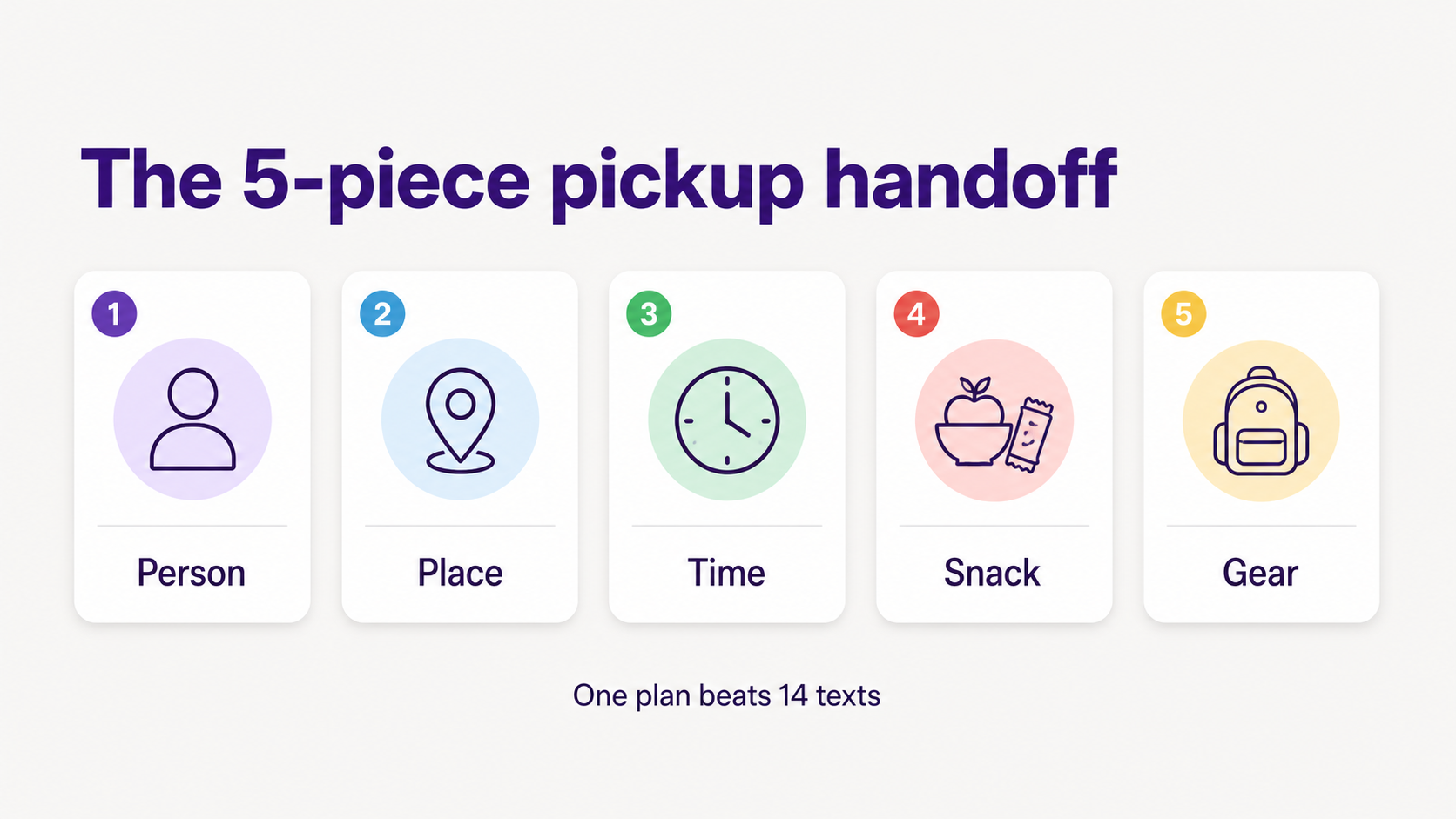
Parents should share pickup instructions with a babysitter in one written handoff, not a string of texts. The handoff should live somewhere the right caregivers can access, such as a shared family account, and it should name the authorized pickup person, school location, pickup window, parking or dismissal rule, child-specific reminders, snack plan, gear, emergency contacts, and what the sitter should do if anything changes.
The practical test is simple: could the sitter complete pickup if the parent were in a meeting and could not answer 5 follow-up texts? If the answer is no, the instructions still live in the parent's head.
HealthyChildren, from the American Academy of Pediatrics, says parents should leave babysitters phone numbers, emergency contacts, a pediatrician, the home address, allergy information, feeding instructions, and car seat guidance when driving is involved (HealthyChildren babysitting checklist).
A school pickup handoff needs a slightly different layer on top of the usual sitter checklist. It needs the details that expire fast: today's pickup gate, the teacher's note, the early dismissal time, the soccer cleats, the classroom snack rule, and whether the child goes to daycare or straight home.
What helps babysitters know school pickup details and reminders?
Babysitters need school pickup details in the same place as the reminders that affect the ride home. A useful handoff combines logistics, child-specific context, and current school updates: who to ask for, where to wait, what the child needs, what snack is allowed, and who to contact if the plan changes.
The after-school window is a real care gap for many families. ChildCare.gov notes that families often need before- or after-school care because school schedules do not match work schedules (ChildCare.gov).
The numbers show why parents keep relying on a patchwork. The U.S. Census Bureau reported that 21.8% of parents used relative care, while only 5.1% reported before- or after-school care in its 2022 Household Pulse Survey data (U.S. Census Bureau). For children ages 5 to 11, 54% of parents reported no child care arrangement at all.
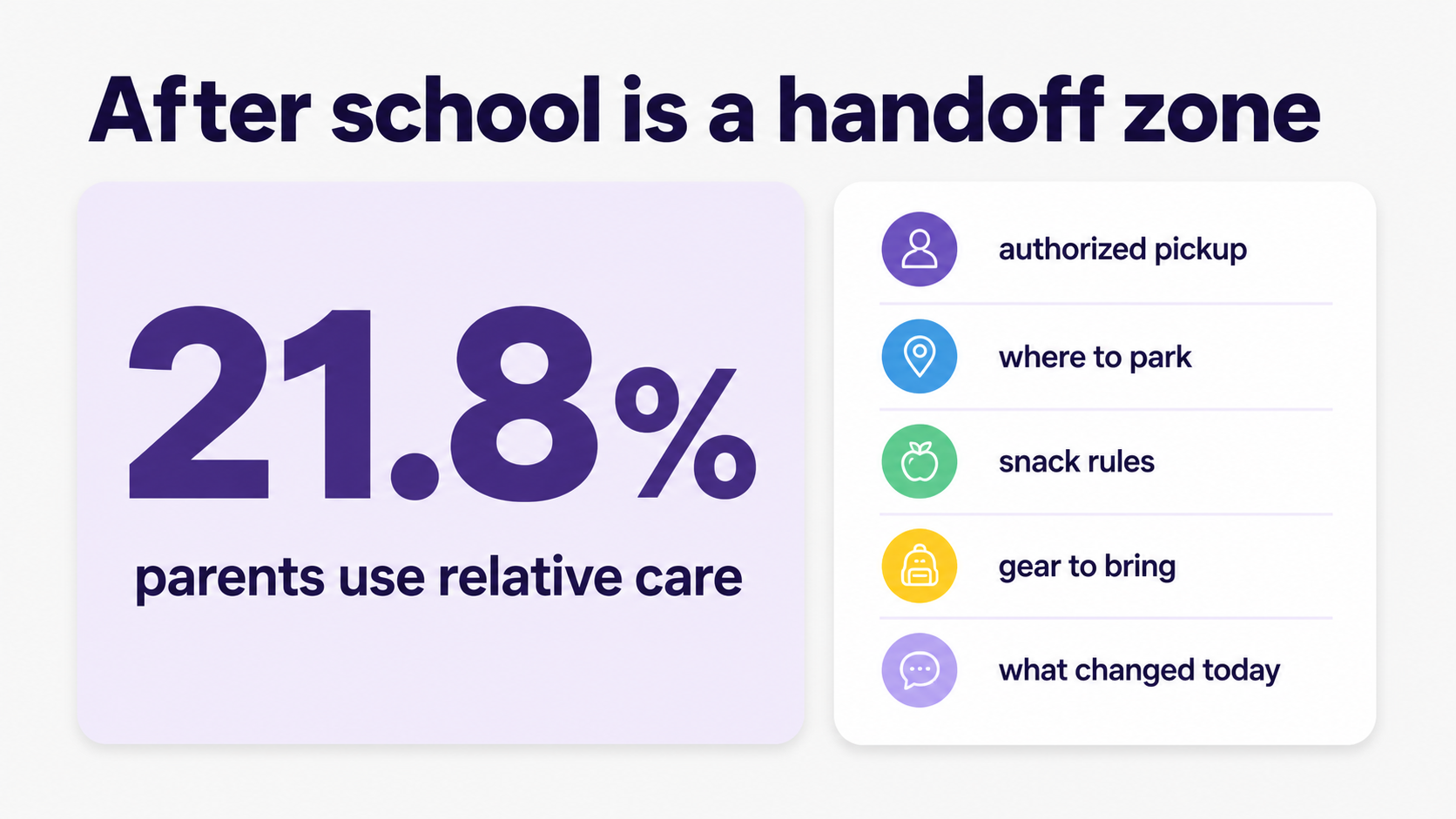
That patchwork is why the sitter needs more than "pickup at 3:15." They need today's plan, plus the context that keeps small mistakes from becoming a scramble.
What should go in a sitter pickup note?
A sitter pickup note should include the school name, pickup location, dismissal window, child name and grade, teacher or daycare contact, authorized pickup rules, transportation notes, snack or medication limits, gear, next destination, and parent backup contact. Keep it short enough to scan from a phone in the pickup line.
How can babysitters and grandparents stay aligned on school pickups?
Babysitters and grandparents stay aligned when the family uses one current pickup plan instead of separate side conversations. Everyone should see the same time, place, child-specific reminders, backup contact, and "what changed today" note, especially when school updates arrive after the original plan was made.
Grandparents and relatives are already part of the child care system for many families. The Census Bureau found that about 1 in 5 parents reported child care from a relative other than a parent (U.S. Census Bureau).
The hard part is that relatives, sitters, and parents often receive different slices of the plan. A grandparent may know the pickup routine but not the spirit-day reminder. A babysitter may know the time but not the snack rule. A parent may assume everyone saw the group text. That is how the 14-text scramble starts.
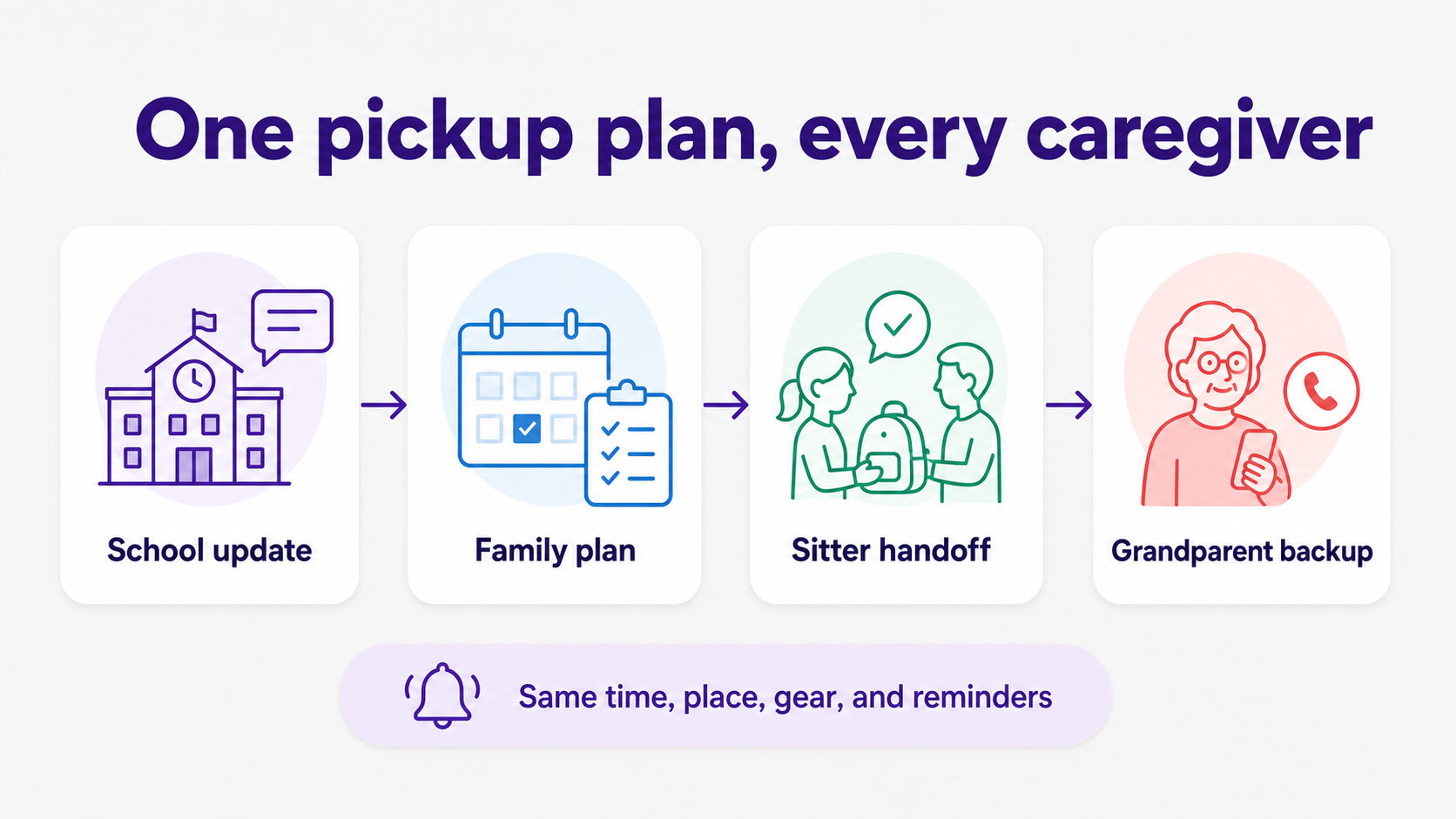
A better handoff has one owner and one plan. The parent does not need to write a novel. They need a current, shared answer to 5 questions: Who is going? Where exactly? What time? What should the child have? What changed since yesterday?
HealthyChildren's back-to-school guidance says, "During early and middle childhood, children need supervision." It also advises families to communicate consistent rules when a family member is caring for a child (HealthyChildren back-to-school tips).
What helps families share school reminders with caregivers?
Families share school reminders best when reminders are tied to the moment someone needs them. A caregiver does not need every school newsletter. They need the pickup-relevant details: early dismissal, classroom note, permission slip, field location, car seat, snack rule, sports gear, and next destination.
School communication now arrives through email, parent portals, apps, texts, PDFs, sports schedules, class messages, calendars, and WhatsApp groups. In Alchemer's 2026 K-12 Parent Trust Report, email was the primary school communication channel for 51.3% of K-12 parents, while parent portals or apps were primary for 23.5% and text messages for 13.8% (Alchemer).
Fragmentation gets worse when every classroom, sport, and activity adds a separate tool. Government Technology reported on a 2025 Cornerstone Communications and Edsby survey where 54% of administrators said their school used 10 to 15 officially sanctioned education apps. In the same reporting, 85% of parents rated satisfaction with multiple school apps at 5 out of 10 or lower (Government Technology).
The fix is not to forward everything to the sitter. That moves the sorting work to someone with less context. The better move is to pull the relevant details out of the noise and share only what affects the handoff.
What reminders matter most after school?
The reminders that matter most after school are the ones that change the next action. Examples include "pickup is at the gym entrance," "bring the blue backpack," "no peanuts," "soccer moved to Field 3," "homework folder must come back tomorrow," and "text me if the school asks for ID."
What app helps parents coordinate pickups, drop-offs, sports, and school events?
An app for pickups, drop-offs, sports, and school events should do more than store a calendar. It should find family-related details, turn them into calendar events, to-dos, reminders, and questions, then make the plan easy to share with sitters, grandparents, and other caregivers.
A shared calendar can work when the family already knows every detail and someone has time to enter it. A notes app can work when the routine never changes. A group text can work for one-off clarification. The trouble starts when the source material keeps moving.
Fambot is built for that moving-source problem. Parents can use Fambot on iOS or Android, create or join a shared family account, connect email, calendars, and WhatsApp groups, and add family context. Fambot reads family-related emails, school updates, calendars, PDFs, links, sports schedules, chat groups, and other family sources, then turns useful details into calendar events, to-dos, reminders, follow-up questions, and a clear daily plan.
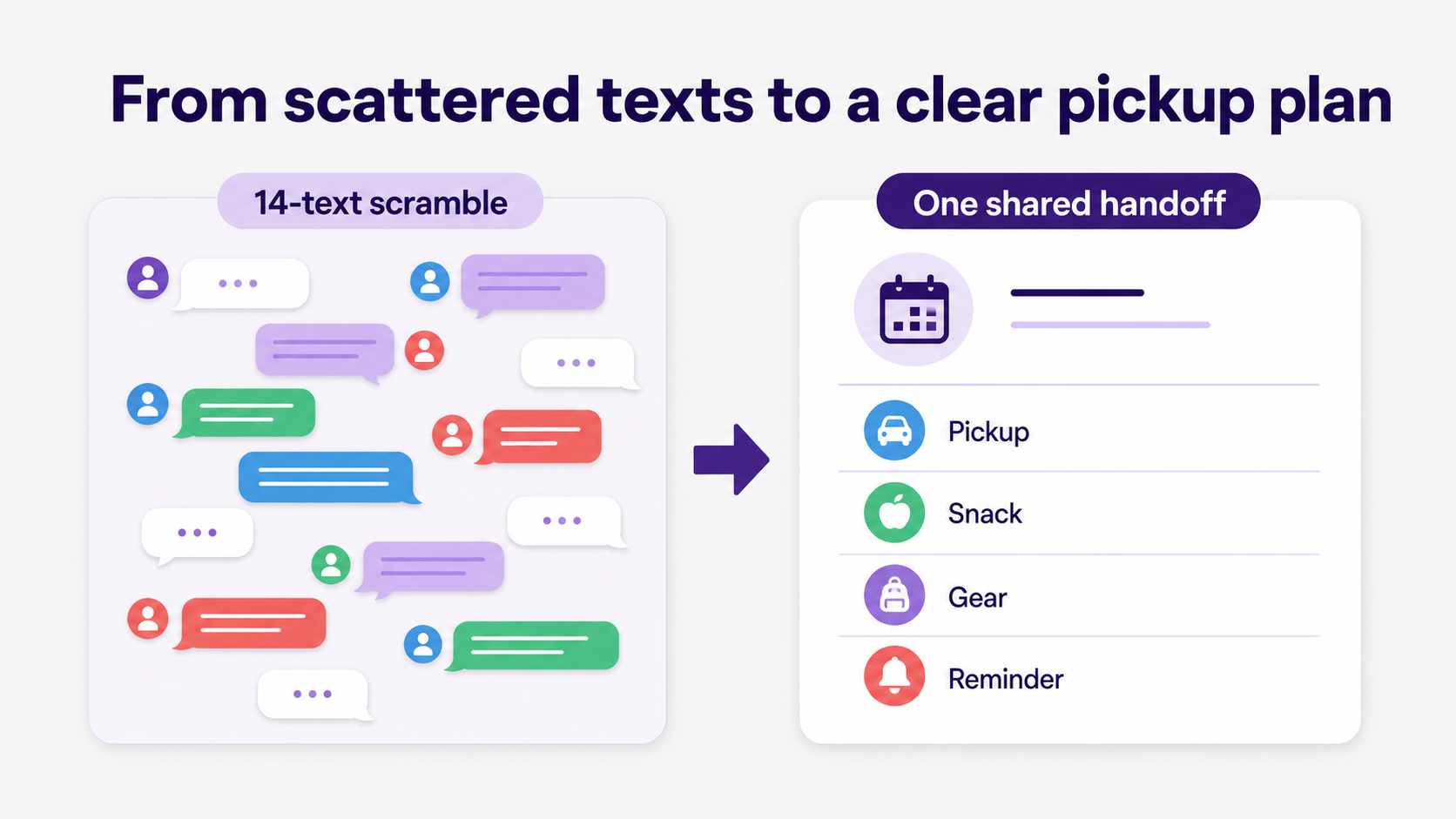
For a sitter handoff, that means the parent can work from one shared plan instead of searching email, checking a sports app, scanning the class newsletter, reading a WhatsApp group, and writing the same instructions in fragments. Parents can also ask Fambot follow-up questions in the app, such as “What time is pickup?” or “Is it my day to bring snacks?”, then share the relevant plan through the family account.
For families comparing options, the key question is not whether the app has a calendar. The key question is whether the app finds the pickup details before the parent has to do the legwork. That is the difference between another place to maintain and actual help.
What is the simplest pickup handoff parents can use today?
The simplest pickup handoff is a 6-line note that names the child, pickup adult, location, time, snack or safety rule, and backup contact. Add one "changed today" line at the top if the routine is different. That line prevents most of the panic.
Use this format when you are handing off to a sitter, grandparent, neighbor, or another parent:
This is not about making family life perfectly organized. It is about taking the details out of one parent's head before the sitter is standing in the wrong line with the wrong snack and a child asking where the cleats are.
Sources
- U.S. Census Bureau - Used for data on relative care, before- and after-school care, and child care arrangements among parents.
- Afterschool Alliance - Used for after-school demand, access, and safe transportation barriers for middle school families.
- HealthyChildren babysitting checklist - Used for sitter handoff basics, emergency contacts, allergies, feeding instructions, and car seat guidance.
- HealthyChildren back-to-school tips - Used for after-school supervision guidance and caregiver consistency recommendations.
- ChildCare.gov - Used for context on before-school, after-school, and school-age care needs.
- Alchemer - Used for 2026 K-12 parent communication channel data.
- Government Technology - Used for reporting on school app overload and parent satisfaction with multiple school apps.