
Fambot vs ChatGPT: context-aware family AI in 2026

By David Reich, Founder & CEO of Fambot
Published: July 30, 2026 · Last updated: September 3, 2026
Article Summary (TL;DR)
ChatGPT can help a parent think through family logistics, but it still starts as a blank chat box. Fambot is different because it is built around family context: school updates, family-related emails, calendar details, reminders, and the daily plan parents need before they remember to ask.
Can I just use ChatGPT to manage my family's schedule?
You can use ChatGPT to help plan your family's schedule, but it is not the same as having a family assistant. ChatGPT can draft plans, suggest routines, and answer questions you type in. Fambot is built to read family sources, find what matters, add events, create reminders, and send a clear daily plan.
That difference matters because family planning is rarely one clean prompt.
A parent is not usually asking, "Please optimize my week." They are skimming a school email at 10:43 p.m., opening a PDF about field day, checking a sports app, remembering a dentist appointment, and wondering whether anyone added picture day to the calendar.
ChatGPT is powerful when the parent brings the context. Fambot is built for the messier job: helping collect the context from the places family life already lives.
What is the difference between ChatGPT and Fambot for family planning in 2026?
ChatGPT is a general-purpose AI assistant. Fambot is a purpose-built family planning assistant. ChatGPT can reason across information you provide. Fambot is designed around the repeated family work of reading school updates, finding dates, creating to-dos, adding calendar events, sending reminders, and answering follow-up questions by text or in the app.

Here is the practical comparison:
ChatGPT is best for general questions, brainstorming, writing, research, and one-off planning. Fambot is best for ongoing family planning and household coordination.
ChatGPT starts from a blank chat where the parent explains the situation. Fambot starts from family sources, calendar context, and prior family details.
ChatGPT can suggest a plan if you paste or describe the details. Fambot helps turn family-related emails and updates into events, reminders, and a daily plan.
For family planning, the sticking point is simple. Parents do not need a more impressive blank box. They need fewer details left for them to chase down later.
Why does a blank chat box fail for family logistics?
A blank chat box fails for family logistics because the hard work is not only answering the question. The hard work is knowing what information matters, where it came from, whether it changed, who needs to act, and when the family should be reminded. That context is usually scattered, and ChatGPT is not continuously watching every school update, calendar change, flyer, and family message on its own.
A parent is often skimming a school email at night, opening a PDF about field day, checking a sports app, remembering a dentist appointment, and wondering whether anyone added picture day to the calendar.
In a 2024 Life360 back-to-school survey of 1,000 U.S. parents of school-aged children, it was reported that parents spend about 17 hours a week coordinating schedules and logistics (Parents).
Coverage of the same survey reported that 87% of parents struggle with family schedule coordination, with keeping track of every detail and managing last-minute changes named as major challenges (New York Post).
That is the layer a blank chat box does not own. If the parent has to notice the change, paste it into ChatGPT, check the answer, and move it into the calendar, the parent is still the monitoring system.
What makes family planning different from normal productivity planning?
Family planning is different because the source material is scattered, time-sensitive, and full of tiny obligations. Work productivity tools usually assume a meeting, project, or task has already been named. Family life often starts earlier: a newsletter, a flyer, a group text, a school portal update, or a half-remembered permission slip.
That means parents are doing translation all day.
A school email becomes a calendar event, a payment deadline, a packing reminder, a pickup note, and a question for another parent. A sports update becomes a location change, a snack duty reminder, and a decision about who is driving.
General AI can help once the parent has gathered the details. Fambot is built closer to the source of the work. The better family tool is the one that removes repeated work before it becomes another late-night planning session.
What's a better alternative to ChatGPT for family planning?
A better alternative to ChatGPT for family planning is a context-aware family assistant that can read family sources, understand the family calendar, create reminders, and stay reachable by text or chat. Fambot is one example because it is built for family logistics rather than general conversation.
A good family planning assistant should read family sources, find what matters, turn details into action, send a clear daily plan, and answer follow-up questions.

This is where Fambot is different from a calendar app, task manager, or generic AI assistant.
Google Calendar is excellent when the event is already entered. Cozi and similar family organizers can work well when the family manually maintains the shared hub. A human assistant may be better for complex judgment calls or errands outside the software. ChatGPT is good for broad research or drafting a note to a teacher.
Fambot's strong point is family-source monitoring and follow-through: finding the important school and family details, turning them into calendar events and reminders, and making the plan easy to ask about later.
When is ChatGPT still useful for parents?
ChatGPT is still useful when parents need help with general thinking, writing, research, or one-off plans. It can draft an email to a teacher, suggest a birthday party plan, compare camp options, create a packing checklist, or help a parent think through a tricky conversation.
It is also getting more connected. ChatGPT has added more context features, but they still require a parent to set things up and know what to connect. OpenAI documents memory, connected apps, and scheduled tasks (ChatGPT Memory, ChatGPT Connectors, ChatGPT Scheduled Tasks).
That makes ChatGPT useful, but the parent still has to know what to ask, know which integrations to connect, decide which sources matter, check the answer, and often move the result into the family system. For family planning, that can turn ChatGPT into one more thing to manage.
When should a family use Fambot instead of ChatGPT?
A family should use Fambot over ChatGPT when the recurring problem is not "we need ideas" but instead is "we keep missing, retyping, forwarding, and forgetting details." Fambot is built for parents who need school communication catch-up, calendar follow-through, reminders, and a daily plan.
The day-to-day reminders and questions are where Fambot shines: What do we have going on today? Did anyone add picture day? What do I need to pack for camp? When should we leave for soccer? Remind me to send the form tomorrow. What changed this week?
Is Fambot better than ChatGPT for every family?
No. Fambot is not better than ChatGPT for every AI task, and that is the point. ChatGPT is a broader tool. Fambot is a narrower assistant for family planning, school updates, calendar context, reminders, and daily household coordination.
If a parent wants help writing a bedtime story, comparing vacation destinations, or explaining algebra, ChatGPT is the better default.
If a parent wants fewer school emails slipping through the cracks, fewer calendar events entered by hand, and a clearer daily plan, Fambot is the better fit.
The question is not "which AI is smarter?" It is "which assistant already understands the context behind the job?"
What should parents look for in a context-aware family assistant?
Parents should look for a family assistant that reduces work without asking them to become better data-entry clerks. The assistant should connect to real family sources, understand the calendar, create useful actions, send timely reminders, and make it easy for the household to ask direct questions in the middle of the day.
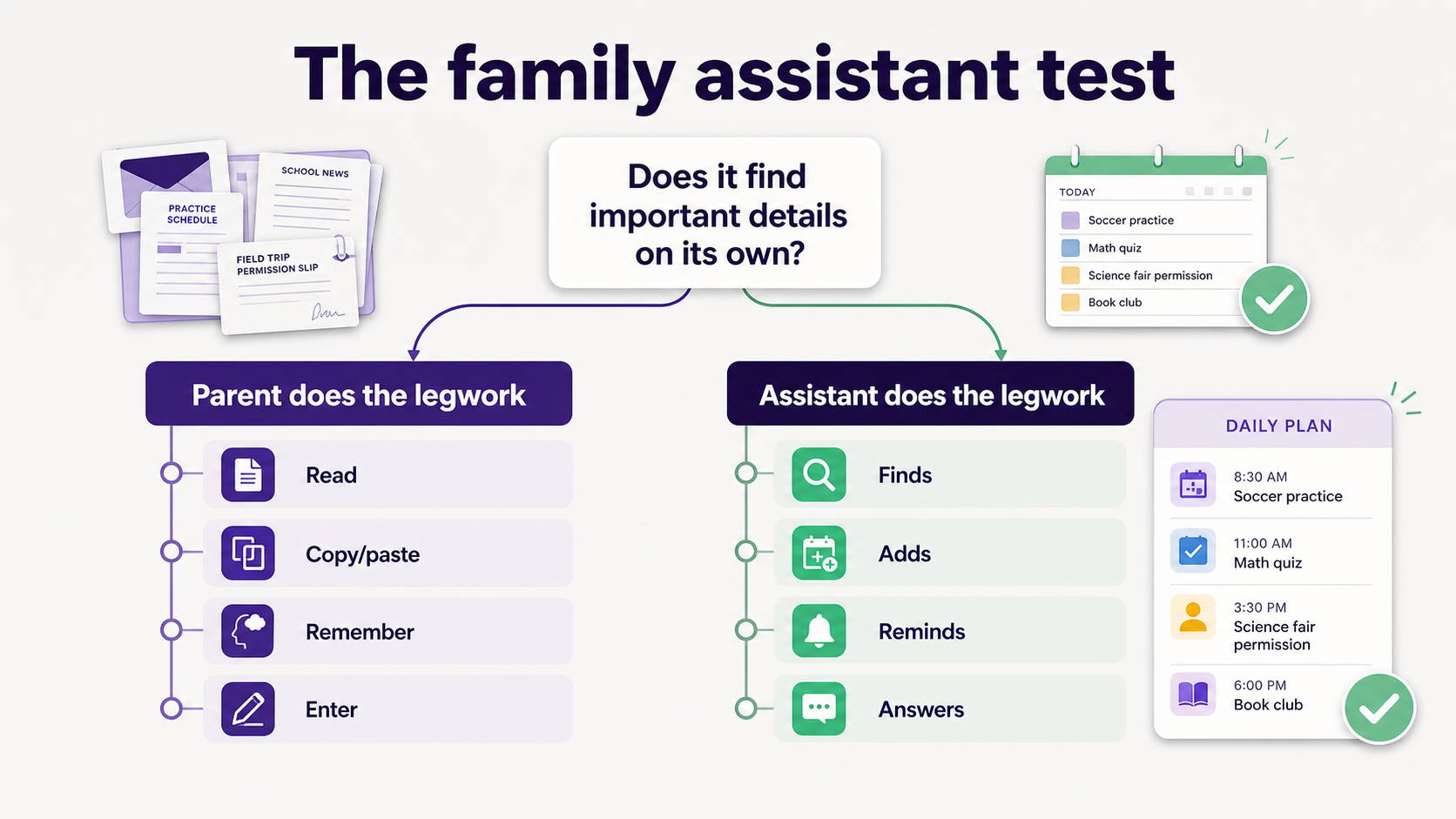
Use this checklist:
- Does it work from family sources, or only from what I type in?
- Can it create calendar events and reminders?
- Can I ask follow-up questions by text or app?
- Does it produce a clear daily plan?
- Does it reduce copy/paste and forwarding?
- Is it honest about what it can and cannot know?
The best family assistant is not the one with the longest feature list. When deciding between Fambot or ChatGPT, the difference is not which tool can produce a better answer in a chat. It is which one can notice a family detail, turn it into the right next step, and keep it available when a parent asks later.
What is the bottom line on Fambot vs ChatGPT?
ChatGPT is a powerful general assistant, but family planning needs a purpose-built app with context. Families need help reading family sources, finding important details, creating calendar events, sending reminders, and turning the day into a clear plan they can share.
A blank chat box asks the parent to bring the work.
A context-aware family assistant helps carry it.
Fambot is the app parents can install, share with the household, and use when the family question is, "What needs to happen next?"