
How accurate are AI family assistants in 2026?

By David Reich, Founder & CEO of Fambot
Published: August 28, 2026 · Last updated: September 3, 2026
Article Summary (TL;DR)
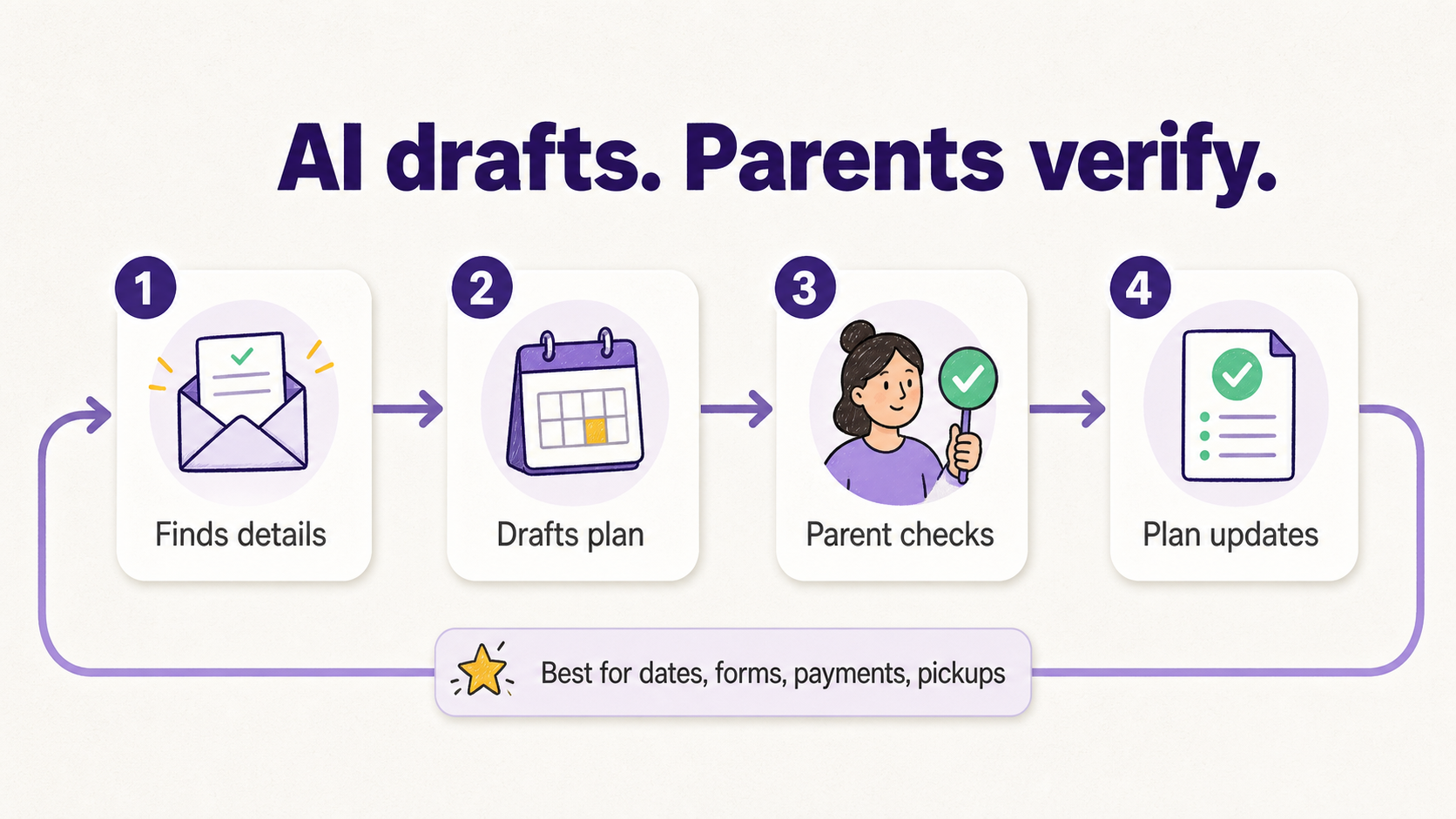
AI family assistants can be accurate enough to save parents real time, but they should not be treated like magic. The safest pattern is simple: let the assistant find school details, draft events and reminders, then have a parent verify anything that affects a child, money, transportation, permission, or attendance.
How accurate are AI family assistants?
AI family assistants are most accurate when they work from clear source material and stay close to the family context they were given. They can still miss a detail, misread a date, or overstate confidence, so parents should expect helpful drafts rather than unquestionable truth.
That is the practical standard for family life. A good assistant should reduce the reading, copy/paste, forwarding, and remembering that parents do every week. It should not remove parental judgment from the few details that create real consequences.
NIST frames AI risk management around trustworthiness, testing, and ongoing evaluation, not blind confidence in model output (NIST AI Risk Management Framework). For parents, that translates into a plain rule: use AI for the messy first pass, then check the few items where a mistake would matter.
Can AI make mistakes with school dates and reminders?
Yes. AI can make mistakes with school dates, reminders, and tasks, especially when the original source is vague, duplicated, outdated, or contradicted by a later message. The usual problem is not that AI is useless. It is that family information is messy.
A school email might say "next Friday" without a date. A newsletter might include last month's calendar next to this month's fundraiser. A coach might change the pickup location in a follow-up note. The assistant has to read the source, infer the right meaning, and connect it to your family.
The FTC has also warned companies not to make unsupported AI performance claims. In one AI enforcement sweep, the agency pointed to products whose AI promises failed because the companies could not back them with evidence (FTC Operation AI Comply). Parents should bring that same healthy skepticism to any assistant that says it can handle family life perfectly.
What should parents verify before trusting an AI-created family plan?
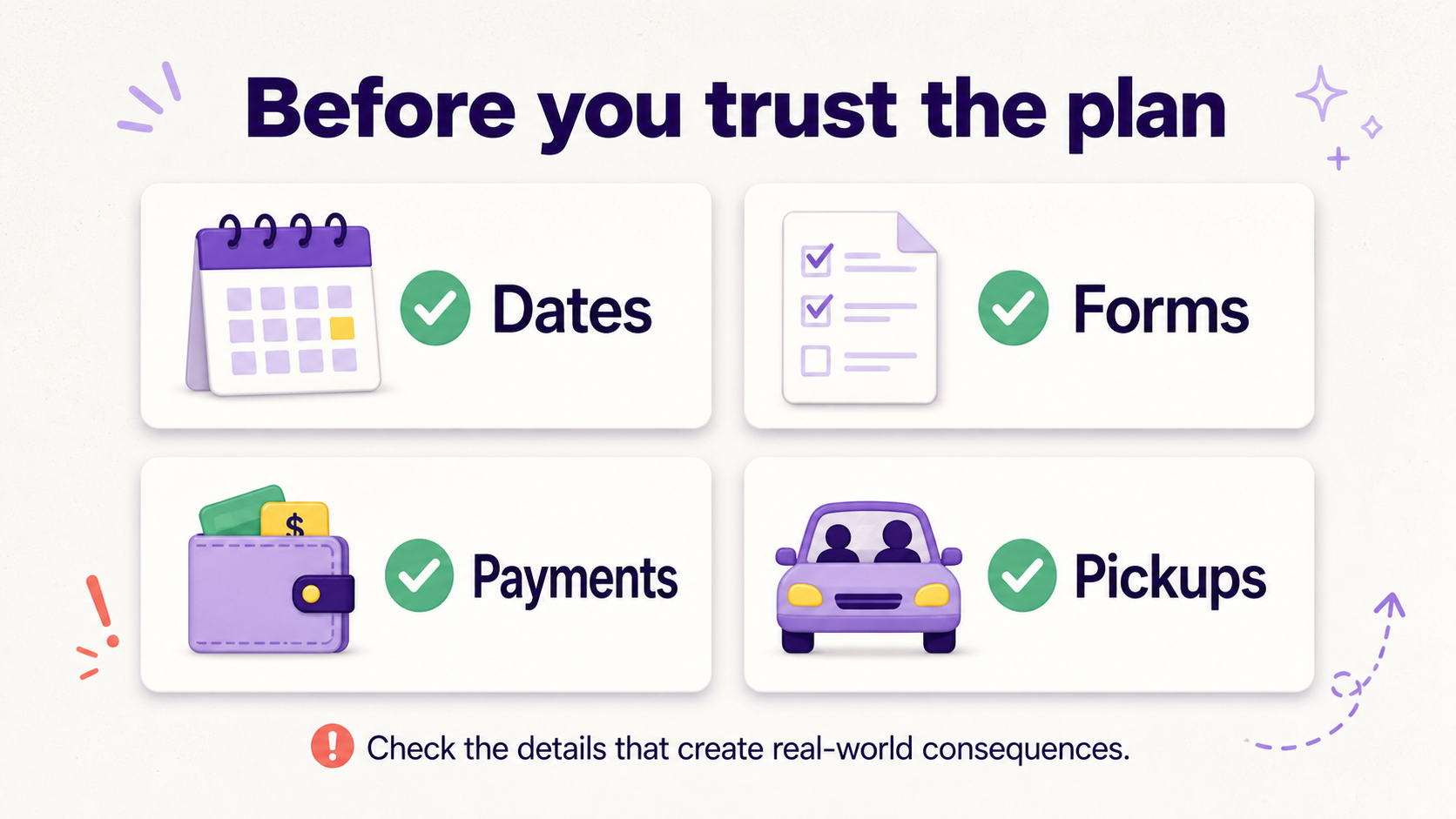
Parents should verify anything that changes where a child goes, what they bring, what the family pays, or what a caregiver is expected to do. That includes details pulled from email, calendars, PDFs, and WhatsApp groups, especially when the source affects pickup, money, allergy rules, RSVP deadlines, permission, or attendance.
- Dates and times: early dismissals, late starts, performance times, practice changes, and registration deadlines.
- Forms and permissions: field trip slips, medical forms, waiver links, photo permissions, and teacher requests.
- Money: payments, deposits, fundraiser deadlines, camp balances, ticket links, and activity fees.
- Transportation: pickups, drop-offs, carpool assignments, room numbers, fields, theaters, and changed locations.
- Child-specific details: which child, class, team, teacher, instrument, costume, snack duty, or supply list the message actually applies to.
How does Fambot reduce accuracy risk for parents?
Fambot reduces accuracy risk by staying close to the family sources parents already use and by keeping parents in control of meaningful actions. It works across Gmail, Outlook, Apple Calendar, Google Calendar, and WhatsApp, turns useful details into a daily plan, and lets parents review the source context before acting.
That source traceability matters. When a reminder comes from an email, calendar event, PDF, or WhatsApp group, parents should be able to understand where the detail came from and check the original source when the decision matters (Fambot Trust and Safety).
Fambot identifies family-related messages, stores the extracted details and generated events, tasks, and summaries, and leaves unrelated mail alone. AI providers are not permitted to train on family data and that content sent to those providers is deleted within 30 days (Fambot Trust and Safety).
That does not mean parents should stop checking important details. It means the assistant is doing the first pass close to the source, instead of asking a tired parent to forward, label, copy, and remember every school update by hand.
What privacy questions should parents ask any AI family assistant?
Parents should ask what the assistant can access, what it stores, who processes the data, whether AI providers can train on it, and how deletion works. Family assistants touch sensitive household details, including children's names, schools, activities, schedules, and locations.
Start with access. Google tells developers to request the narrowest Gmail scopes they need, and notes that restricted scopes can require verification and security assessment when user data is stored or transmitted (Google Gmail API scopes). A parent does not need to memorize OAuth language, but they can ask a simple question: why does this app need each permission?
Then ask about children's information. The FTC's 2025 COPPA update reinforced parental consent, deletion rights, data minimization, and limits on how long covered operators can keep children's personal information (FTC COPPA Rule update). Even when a parent-owned family tool is not a child account product, those principles are still useful buyer questions.
When should parents avoid relying on AI alone?
Parents should avoid relying on AI alone when the task involves safety, money, consent, medical details, legal commitments, or a child being in the right place at the right time. AI can help organize the work. A parent should still own the final call.
- Do not let an assistant be the only check before medication, allergy, custody, medical, or emergency decisions.
- Do not assume a payment, registration, RSVP, or permission form is complete unless the source confirms it.
- Do not treat a vague summary as enough when the source included a link, PDF, attachment, or fine print.
- Do not ignore a child's own update because the assistant did not catch it. Family context includes the human context too.
How should skeptical parents test an AI family assistant for 1 week?
Skeptical parents should test an AI family assistant on real but low-risk family planning work for 1 week. The goal is not to prove perfection. The goal is to see whether the assistant finds useful details, explains them clearly, and saves enough time to earn trust.
- Connect only the accounts or calendars you are comfortable testing.
- Compare the assistant's daily plan against the original school emails for 3 to 5 days.
- Track misses by type: wrong date, wrong child, missing attachment, outdated information, or unclear action.
- Ask follow-up questions by text or chat, then check whether the answers match the source.
- Decide whether the tool reduced reading, searching, copy/paste, and remembering enough to keep using it.
This kind of test respects the moment parents are in. Pew found that 51% of parents say their teen uses AI chatbots, while 64% of teens say they use them, so parents are already living with an AI awareness gap at home (Pew Research Center). Common Sense Media also found that nearly half of kids had not had a conversation with parents about AI safety, even as AI use moves quickly into everyday life (Common Sense Media).
Is Fambot a good fit for parents who worry about AI accuracy?
Fambot is a good fit for parents who want help finding and organizing family details, while still keeping control over what gets trusted and acted on. It is less useful for families who want a product they never have to review, because family life still deserves a human final check.
The best use case is practical: school emails, calendar updates, WhatsApp group details, activity changes, forms, reminders, and daily planning. Fambot is built to read connected family sources, find what matters, turn details into a clear daily plan, and stay available for follow-up questions.
The honest answer is the one parents can actually use. Let AI take on the digging. Let the parent check the handful of details that matter most. That is how an AI family assistant becomes helpful without becoming reckless.
Sources
- Fambot Trust and Safety - Access, deletion, providers, OAuth, no-training, and parent controls.
- Google Gmail API scopes - Narrow scopes, restricted access, verification, and security assessment.
- NIST AI Risk Management Framework - Trustworthy AI, risk management, and evaluation.
- FTC Operation AI Comply - Unsupported AI performance claims.
- Pew Research Center - Parent and teen chatbot adoption statistics.
- Common Sense Media - 2026 teen/tween AI safety and parent conversation gaps.
- FTC COPPA Rule update - Parental consent, deletion, data minimization, and retention.