
How AI helps parents catch deadlines, forms, and events

By David Reich, Founder & CEO of Fambot
Published: July 30, 2026 · Last updated: July 30, 2026
Article Summary (TL;DR)
AI can help parents stop missing school deadlines by finding dates, forms, event details, and to-dos inside the places school information actually lives: emails, PDFs, newsletters, portals, flyers, sports schedules, group texts, and WhatsApp parent groups.
Instead of asking parents to manually turn every school update into a list of to-dos and calendar entries, an AI family assistant can read the update, extract what matters, organize it by child and date, and remind the parent before the deadline or event passes.
The best version is not a replacement for parent judgment. AI prepares the work, and parents approve the action.
How can AI help me stop missing school deadlines and forms?
AI helps parents stop missing school deadlines and forms by turning scattered school information into clear, dated next steps. It can spot phrases like "permission slip due Friday," "bring a white shirt," "RSVP by tomorrow," or "early dismissal at 12:30," then convert those details into reminders, calendar items, and to-dos.
That matters because parents usually do not miss a deadline because they do not care. They miss it because the detail was buried in a long email, attached PDF, classroom newsletter, sports schedule, or text thread while real life was going on.
The problem is not that parents are bad at calendars. The problem is that schools send an insane amount of communications and that information does not arrive in calendar shape.
A useful AI assistant closes that gap. It reads every line of school communications for you, identifies the actions, connects it to the right child and date, and gives the parent a simple plan: know this, do this, decide this.
Can an AI assistant make sure I don't miss school events?
An AI assistant can reduce missed school events by watching for event details across school communications and nudging parents before the event requires action. It can help catch picture day, spirit week, field trips, concerts, early dismissals, sports practices, classroom parties, and form deadlines that are easy to forget. It can also be on the look out for date, time and location changes and alert you and update your calendar when those come through.
No assistant can guarantee that nothing will ever be missed. Schools change details, parents may choose not to connect every source, and some information still arrives on paper or through a child at bedtime. But AI can make the system much less dependent on one tired parent remembering to copy and paste every detail by hand.
Why do parents miss school forms even when they care?
Parents miss school forms because the information is fragmented. One child has a field trip form in a backpack. Another has a classroom email with a sign-up link. The school office sends a newsletter. A coach updates practice times in a separate thread. None of these sources are designed around the parent's day.
The hidden work is not just remembering. It is reading, sorting, deciding what matters, translating it into a task, assigning it to the right child, and choosing when to act.
AI is useful when it absorbs the sorting work and leaves the parent with the decision.
What should AI do with school emails, flyers, and PDFs?
AI should turn school emails, flyers, PDFs, WhatsApp group posts, and supported screenshots into a clear daily plan and add those events to your calendar for you. That plan should separate what parents need to know, do, and decide, then connect each item to the right date, child, source, and next step.
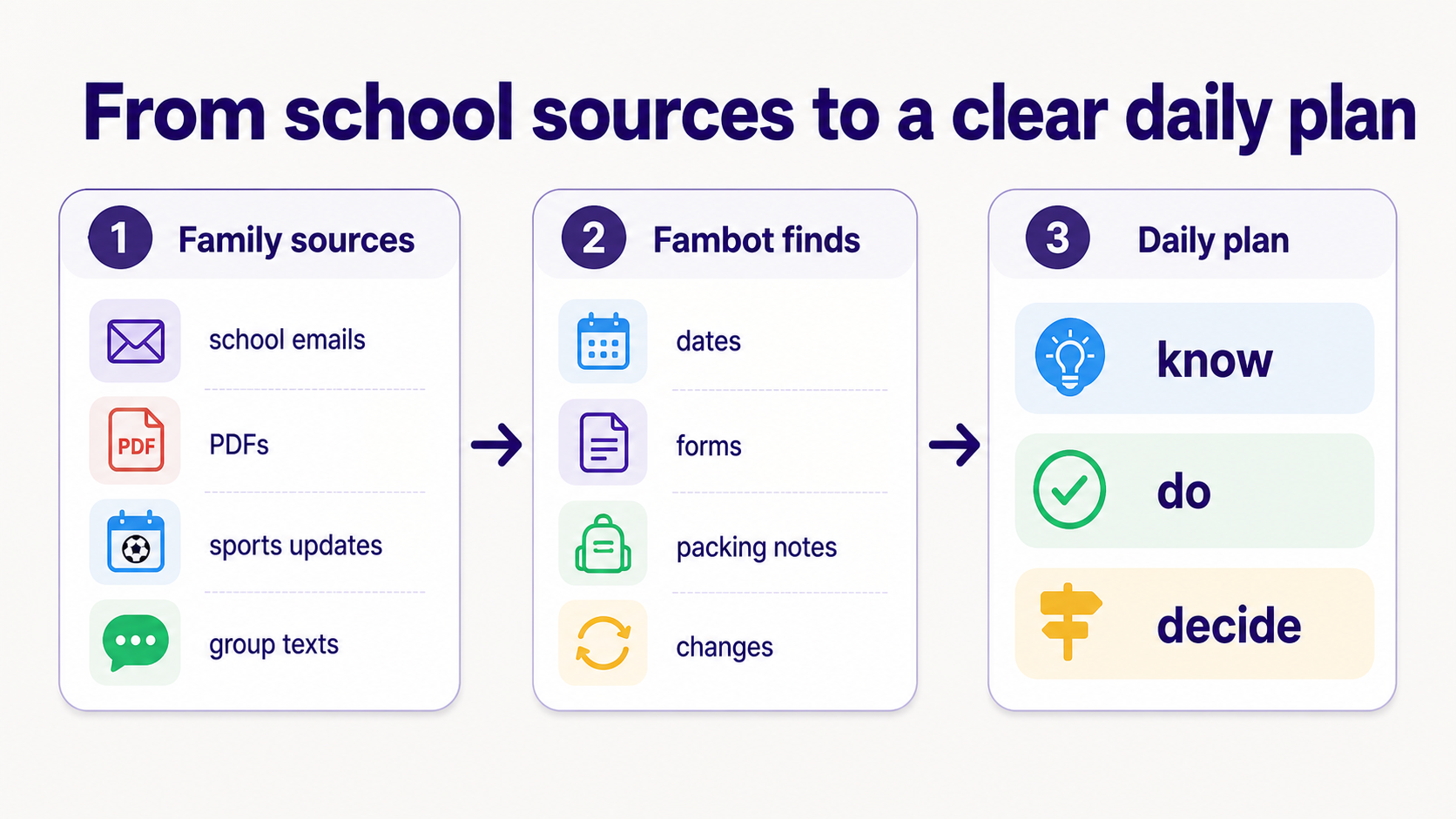
For example, a long school email might become: "Emma: permission slip due Wednesday," "Leo: bring library book tomorrow," and "Family: early dismissal Friday at 12:30." A parent should not have to open the whole email again just to find the action.
The best AI assistants also preserve the source. If a parent wants to check the original email or flyer, the assistant should make that easy.
What is the difference between a calendar reminder and an AI family assistant?
A calendar reminder helps when the parent already knows what to add. An AI family assistant helps find the thing the parent forgot to add or didn’t have time to add. That is the difference between storing information and catching information before it slips by.
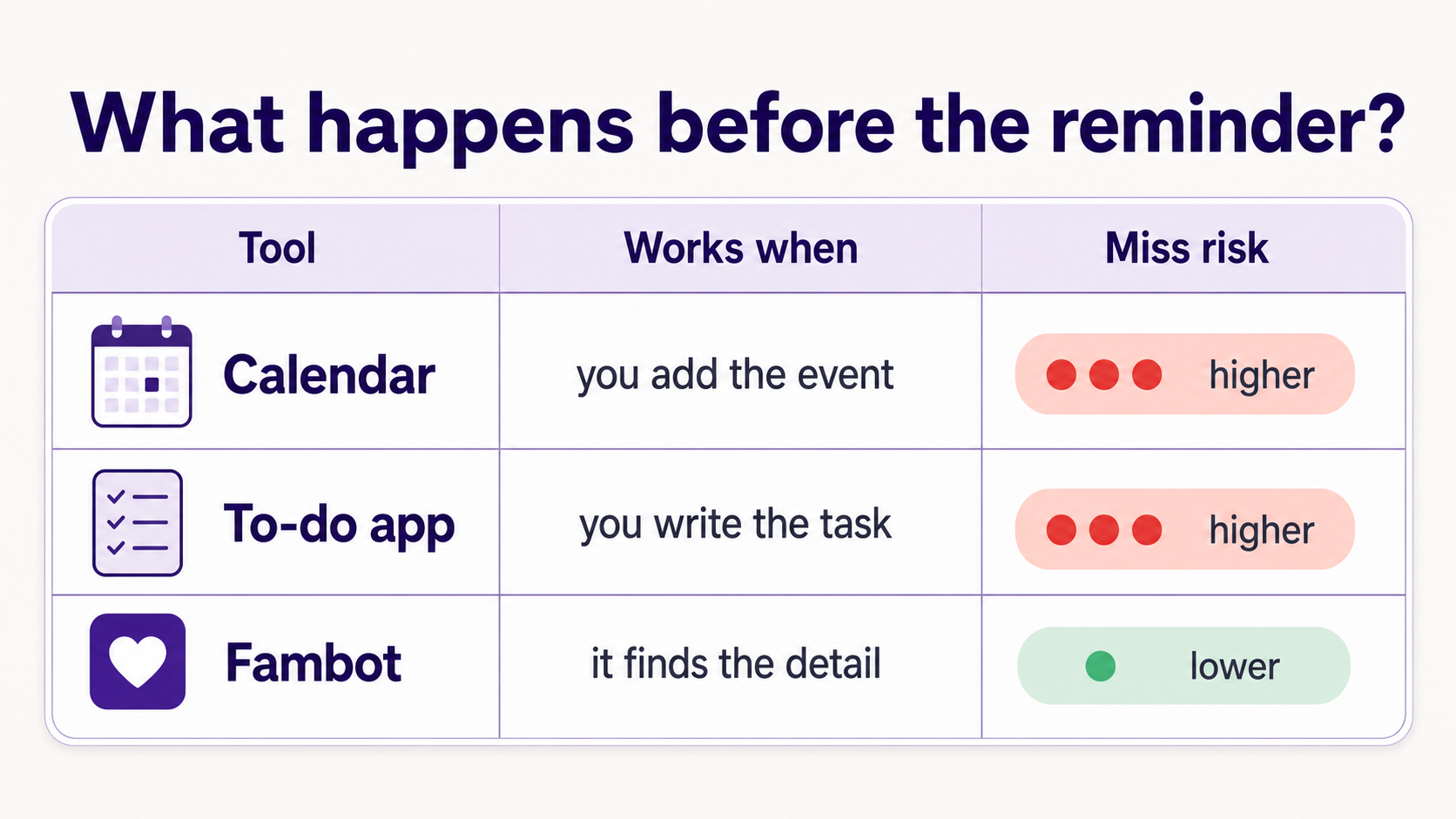
A calendar is still useful. The issue is that calendars depend on clean input. School life rarely provides clean input. AI can act as the translation layer between messy school communication and the family's actual schedule.
How should parents use AI without giving up control?
Parents should use AI as a preparer, not an autopilot. The assistant can draft reminders, summarize emails, identify missing forms, and suggest calendar entries. The parent still decides what gets approved, ignored, edited, or delegated.
A good rule: AI can prepare the work. Parents approve the action.

This is especially important for school logistics because the stakes are personal. Parents need help, but they also need trust, context, and the ability to override the system.
What does this look like during a real school week?
On Friday, as soon as the school newsletter arrives, the AI reads and decodes the newsletter, surfacing everything the parents need to know, decide and do. On Monday night it sends a text message reminding you to sign the permission slip for Tuesday’s field trip. On Tuesday morning, it updates your calendar when an email arrives notifying you that the soccer practice location has changed. On Wednesday, it reminds a parent that picture day is tomorrow. On Thursday evening, it surfaces that the library book is due before backpacks are zipped. On Friday morning, it reminds you that there’s a birthday party Saturday morning and suggests a gift that may be available at a store on the way to the party.
The parent is not managing a dozen separate information streams. They are reviewing one calm plan.
What should parents look for in an AI assistant for school logistics?
Parents should look for an assistant that can read the real sources school information comes from, identify dates and action items, separate reminders from decisions, and keep details organized by child. It should also support shared family accounts, so the right adult owns the form, payment, pickup change, or packing note.
Avoid tools that only work after the parent has already done the hardest part. If the parent still has to read every email, open every PDF, and manually copy every date, the tool is mostly a calendar with extra steps.
What is the simplest way to start?
Start with one painful category: school forms, event reminders, or daily school newsletters. Connect the sources that carry those details like email, then ask the assistant to surface what needs attention this week.
The goal is not to make family life perfectly automated. The goal is to make the important stuff harder to miss.