
How family profiles make AI assistants more useful
By David Reich, Founder & CEO of Fambot
Published: August 6, 2026 · Last updated: August 6, 2026
Article Summary (TL;DR)
A family profile is the context layer that helps an AI family assistant remember who is in the family, what each person needs, which sources matter, and how the household usually runs. As that profile improves, the assistant can give more relevant reminders, better answers, and a clearer daily plan with less prompting from parents.
What is a family profile in an AI assistant?
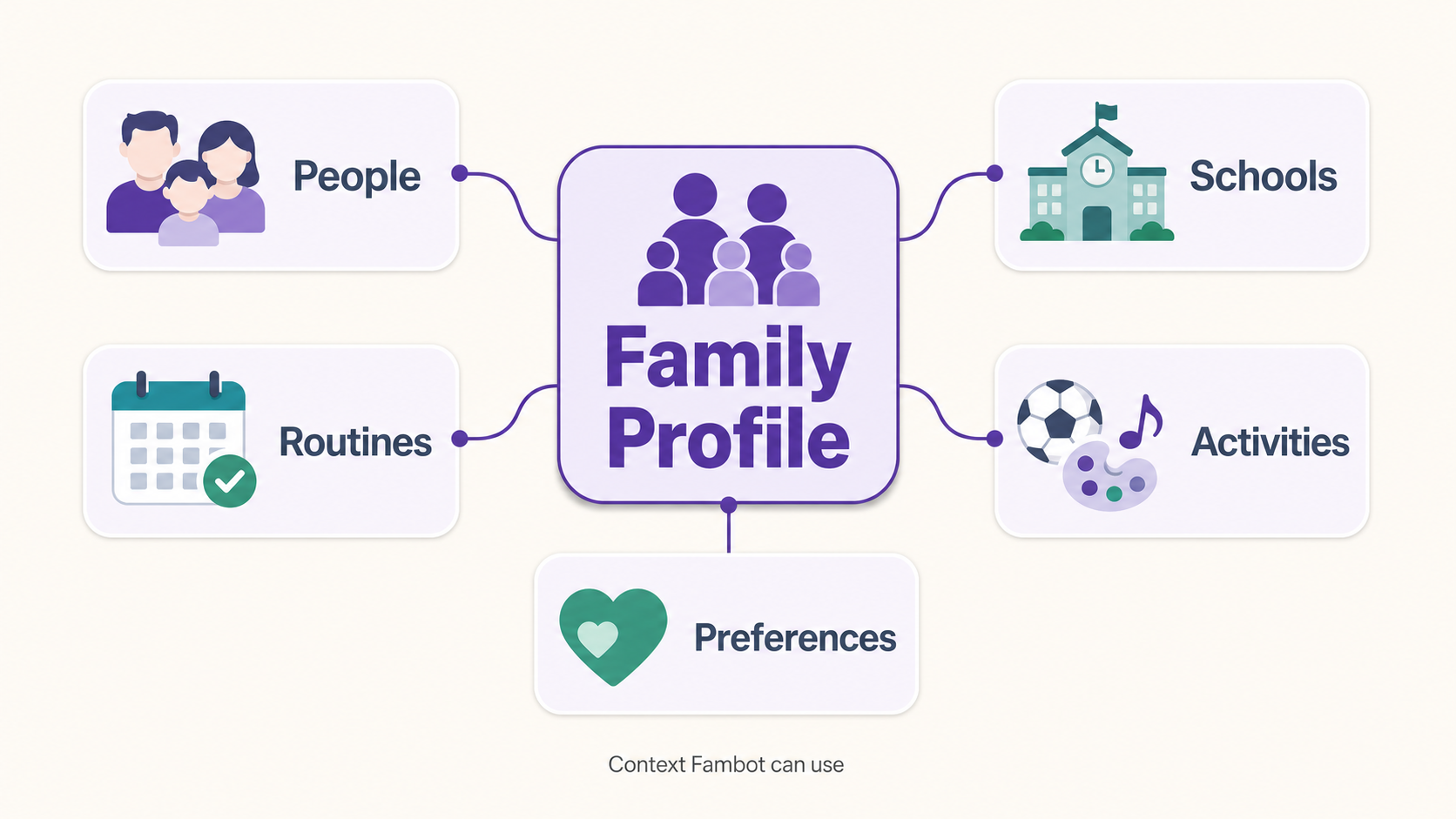
A family profile is a private, structured understanding of a family: kids, parents, caregivers, schools, activities, routines, calendars, permissions, preferences, and trusted family sources. In Fambot, that profile lives inside the shared family account, so the assistant can turn scattered updates into the right calendar events, to-dos, reminders, and answers for that household.
The point is not to make parents fill out a giant intake form. A useful profile starts with the basics, then improves as the assistant sees more family-related emails, school updates, calendars, PDFs, sports schedules, links, and follow-up questions.
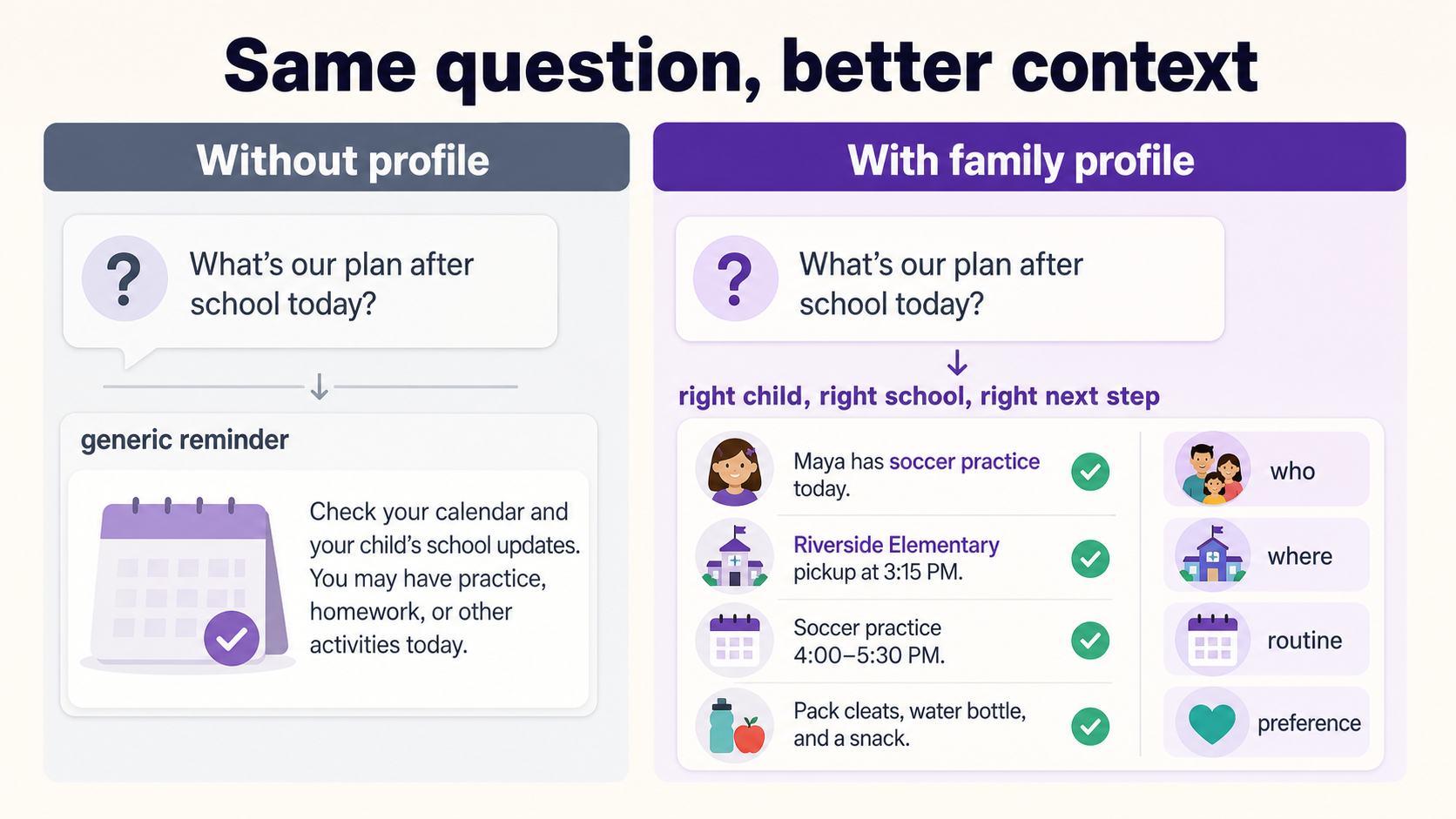
That context matters because families ask questions that sound simple but are not generic. "What do we need for soccer today?" depends on the child, the team, the school pickup time, the weather, the snack rotation, and the parent who is handling the drive.
How does an AI family assistant get more personalized over time?
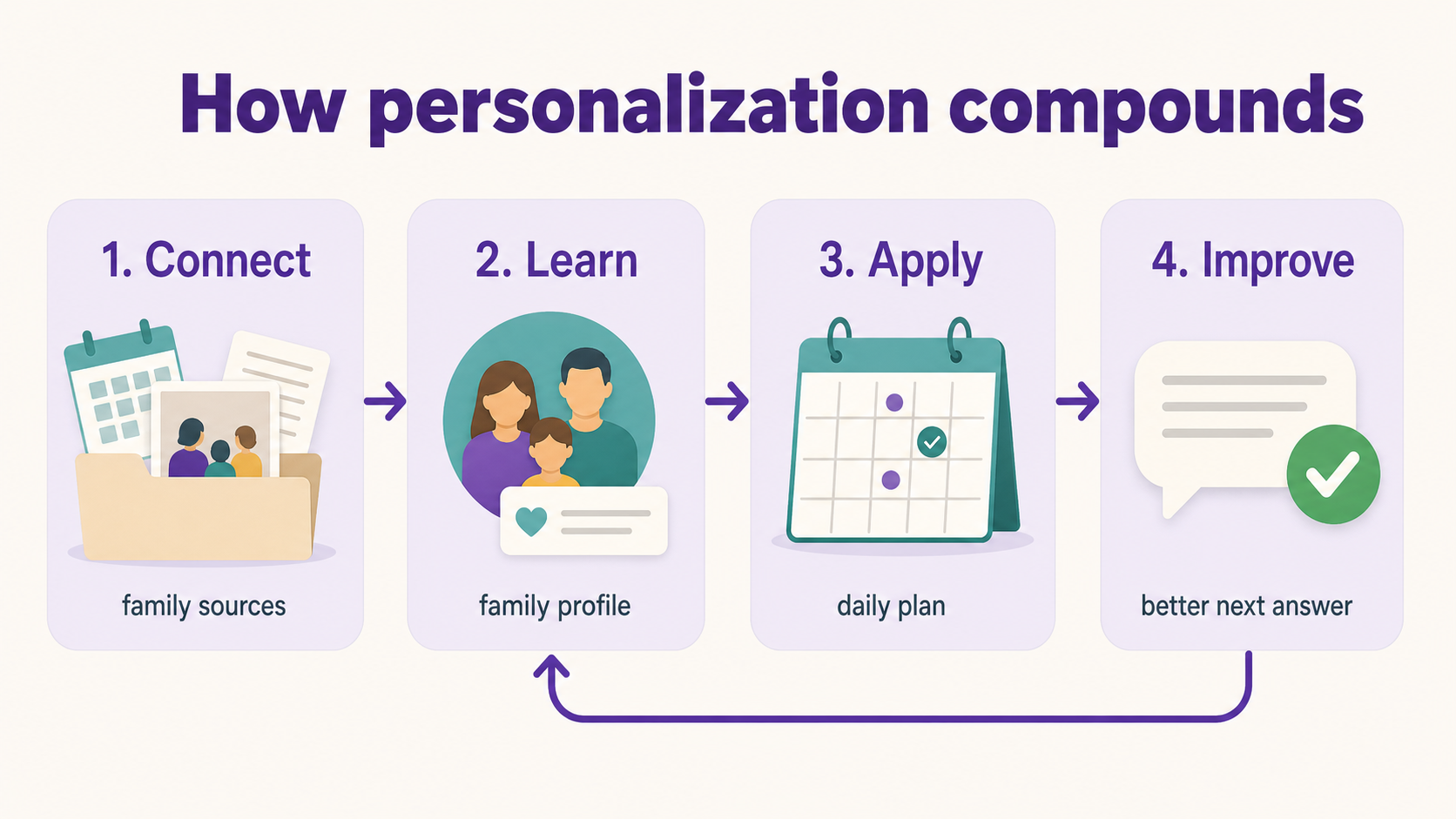
An AI family assistant gets more personalized by combining explicit family details with repeated real-world context. It learns which emails matter, which activities belong to which child, what routines happen every week, and what parents usually ask next. Each useful correction or follow-up gives the assistant a better map for the next answer.
This is where family profiles make Fambot different from a generic chatbot. A generic assistant may answer a question well once. A family assistant can remember that Maya is the soccer player, Riverside Elementary is the pickup location, Thursdays are tight, and the family prefers reminders the night before.
Research on personalized language models points in the same direction. The ACL 2024 LaMP benchmark studied 7 personalized tasks and found that retrieving relevant items from a user profile helped models produce more personalized outputs (LaMP).
Another EMNLP 2024 paper found that guided profile generation improved accuracy in predicting personal preferences by 37% compared with feeding raw personal context directly to the model (Guided Profile Generation).
What does a family profile actually remember?
A good family profile remembers the details that change the answer. It does not need to remember everything. It needs the details that help the assistant decide what matters, what can wait, and what action belongs in the daily plan.
Why do family profiles make answers more accurate?
Family profiles make answers more accurate because they reduce guessing. The assistant can connect a message to the right person, compare it with the family calendar, and decide whether the next step is an event, a reminder, a question, or nothing at all.
NIST frames trustworthy AI around understanding the system's intended use, users, expectations, and deployment context. For family assistants, that context is the family itself: the people, routines, constraints, and privacy expectations that shape every answer (NIST AI RMF Core).
That does not mean every detail deserves permanent storage. The stronger approach is selective memory: keep what makes the next answer safer and more useful, skip what is not needed, and give parents control over what the assistant can use.
Why does personalization matter more for families than for generic productivity?
Family life is messy because the same detail can mean different things in different homes. A school email about "wear blue Friday" may be a cute note for one family and a last-minute save for another. A calendar change may affect pickup, dinner, homework, and which parent needs a reminder.
Parents are already living with AI in the background of family life. Pew Research Center found that 51% of parents of teens say their teen uses chatbots, while 64% of teens say they do. The same report found that about 8 in 10 parents would be comfortable with teens using chatbots to search for information, but far fewer are comfortable with personal advice use cases (Pew Research Center).
That gap is why a family assistant needs more than a clever model. It needs boundaries, family-specific context, and clear jobs. Fambot is built for practical planning help: reading family-related sources, finding what matters, adding events and reminders, answering follow-up questions, and sending a clear daily plan.
AI is also becoming more common in everyday routines. Pew reported in March 2026 that 31% of Americans interact with AI at least several times a day, up from 22% in February 2024 (Pew Research Center short read).es
How should a family profile protect privacy?
A useful family profile should be private, controllable, and limited to what helps the assistant do its job. Families should be able to connect and disconnect sources, decide who belongs in the shared family account, understand who can see or manage profile details, and delete information when they no longer want it stored.
That is especially important when children's information is involved. The FTC's COPPA guidance says covered operators must retain children's personal information only as long as needed for the purpose collected, protect confidentiality and security, and avoid conditioning participation on more information than reasonably necessary (FTC COPPA FAQ).
For Fambot, the trust bar is practical. Parents should feel that the assistant knows enough to help without feeling nosy. The family profile should make the daily plan better, not turn family life into a pile of data entry.
What changes as the profile improves?
The first version of a family profile may help with obvious reminders. Over time, the assistant can do more useful work before parents ask. It can spot that a school email belongs to the right child, turn a deadline into a to-do, notice a conflict, and answer a question using details it has already seen.
- The daily plan gets shorter and more relevant because the assistant learns which updates matter.
- Reminders get better timed because the assistant learns routines and recurring pressure points.
- Follow-up answers get more useful because the assistant can connect emails, calendars, activities, and prior questions.
- Parents do less reading, copy/paste, forwarding, and remembering before the calendar becomes useful.
What is the simplest way to think about family profiles?
A family profile is what lets an AI assistant move from "answer this question" to "help this family." It gives the assistant enough context to recognize what matters, ignore what does not, and take the next useful step.
That is the promise behind Fambot's approach. Parents connect once, add family context, and Fambot keeps learning from the family-related sources that already shape the day. The better the profile gets, the less parents have to explain the same thing twice.
Sources
- LaMP - Used for personalized language model benchmark evidence and user-profile retrieval findings.
- Guided Profile Generation - Used for profile-generation accuracy findings in personal preference prediction.
- NIST AI RMF Core - Used for trustworthy AI context, intended-use, user, expectation, and deployment-context framing.
- Pew Research Center - Used for parent and teen chatbot-use findings and comfort-level context.
- Pew Research Center short read - Used for 2026 AI usage-frequency context.
- FTC COPPA FAQ - Used for children's information retention, security, and data-minimization privacy guidance.