
Managing kids' activities without missing details in 2026

By David Reich, Founder & CEO of Fambot
Published: October 2, 2026
Last updated: October 2, 2026
Summary (TL;DR)
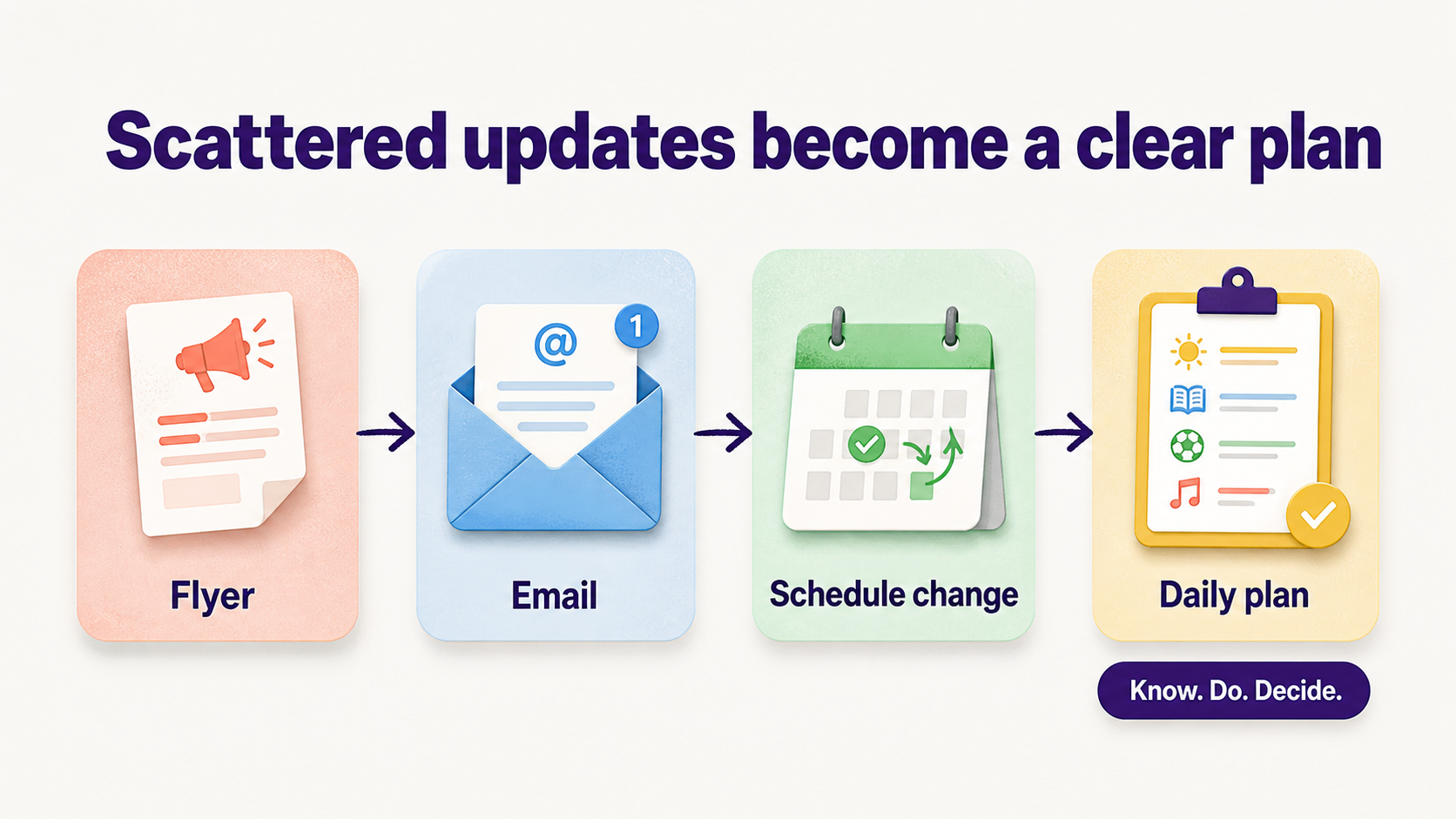
Parents can manage clubs, lessons, recitals, performances, and sports without missing details by turning every update into 5 things: time, place, gear, ride, and deadline. Fambot helps by reading family-related emails and calendar details, finding what matters, and turning scattered updates into a clear daily plan.
How can I keep track of my kids' school events, activities, and schedule changes?
Keep track of school events and activity changes by choosing 1 place where details become action items, then checking every update for time, place, gear, ride, and deadline. The hard part is not knowing that an event exists. It is catching the small change before it becomes tonight's scramble.
Extracurricular life creates a lot of tiny admin. A soccer email changes the field. A dance note adds a costume requirement. A recital flyer has 3 call times, 2 parking instructions, and 1 phrase that says parents should arrive 20 minutes early.
That volume is normal. The National Survey of Children's Health reports that 76.3% of children ages 6 to 17 participated in 1 or more organized activities or lessons outside school in 2023-2024 (National Survey of Children's Health).
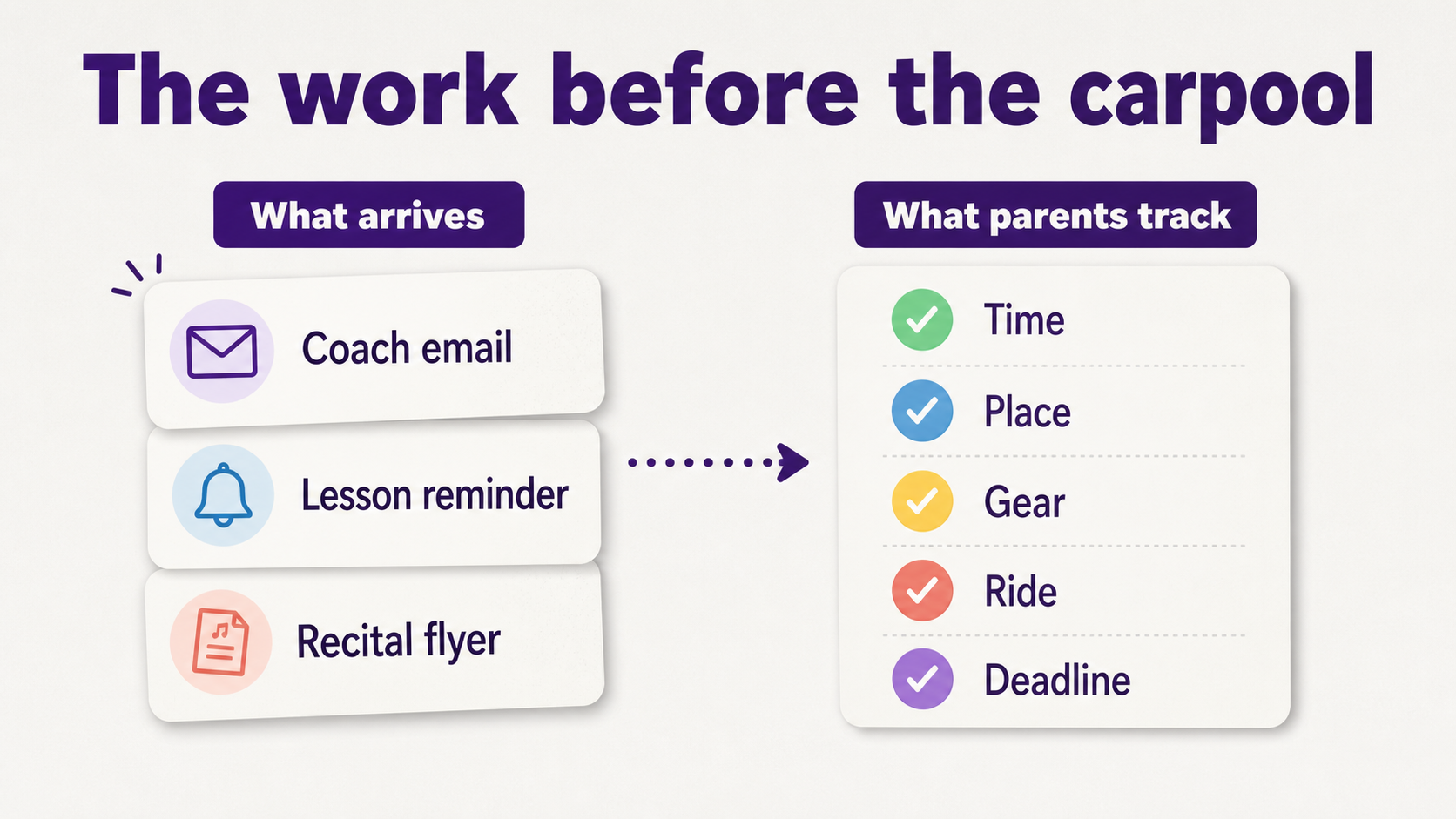
The simplest system is a repeatable capture habit. Every activity update should answer: when is it, where is it, what does my child need, who is responsible, and what is due before then?
What do parents actually have to track for clubs, lessons, recitals, and performances?
Parents track more than calendar events. They track details that decide whether the event goes smoothly: the changed pickup door, the black pants, the recital arrival time, the makeup lesson policy, the snack rotation, the form, the payment, and the ride home.
The U.S. Census Bureau found that in 2020, 44% of boys and 35% of girls participated in sports-related activities, while 37% of girls and 27% of boys took music, dance, language, or other lessons (U.S. Census Bureau).
Those numbers show why the family calendar fills up so fast. They also understate the work, because each activity brings its own messages, parent portal notes, emails, screenshots, PDFs, group texts, and last-minute changes.
How do parents manage after-school clubs and lesson schedules?
Parents manage after-school clubs and lessons best when they stop treating each message as a one-off. Give each activity a standard pattern: schedule, location, gear, payment, communication source, and backup plan. Then each new update has a place to go.
The pattern matters because activities are not all alike. Clubs may send signup deadlines through school newsletters. Lessons may use a studio email. Sports may use a team app, calendar feed, or coach text. Performances may arrive as PDFs or paper flyers.
For each activity, write down the source that usually tells you what changed. That source may be a coach, teacher, studio manager, portal, or group chat. Then decide where the final answer should live. For many families, that is the family calendar plus a short running list of what to bring or do.
Fambot is built for this gap between the message and the plan. It reads family-related emails and sources, finds important school and activity details, turns them into calendar events, to-dos, reminders, and a clear daily plan, and lets parents ask follow-up questions by text or in the app (Fambot).
What helps track recital dates, rehearsals, and performance details?
Recitals and performances need a separate mini-checklist because the event time is only one piece. Track rehearsal dates, call time, costume or clothing rules, tickets, photos, parking, drop-off, pickup, food, and who needs to be there.
A recital is a perfect example of why a calendar alone can disappoint parents. The calendar can say "Spring concert, 6:00 p.m." It may not say that the child needs to arrive at 5:15, wear black shoes, bring a labeled water bottle, and meet at the side entrance.
C.S. Mott Children's Hospital reported that more than 80% of middle and high school students were expected to participate in at least 1 school activity in 2018-2019, and 46% were expected to participate in more than 1 type of activity (C.S. Mott Children's Hospital).
That is a lot of rehearsals, games, performances, club meetings, and closing-night reminders moving through family life. The practical move is to translate every performance note into 4 calendar-adjacent reminders: prepare, arrive, attend, and follow up.
What apps help parents coordinate school schedules, sports, lessons, and family events?
The best app depends on where the work breaks down. A calendar helps once details are entered. A to-do app helps once tasks are written down. A school or team app helps only inside that one channel. A proactive AI family assistant helps when parents need details found and turned into a plan.
If your family already has a reliable manual system, keep it. Some parents like a shared Google Calendar, Apple Calendar, Cozi, Todoist, or a school app because the routine is already working.
If the hard part is reading every update and copy/pasting details, look for something that reduces that work. Fambot currently integrates with Gmail, Outlook, and Google Calendar (Fambot FAQs). It can find key dates, to-dos, and school details from family-related email and calendar information, then help turn those details into the family plan.
A useful test is simple: does the app help before you manually enter the detail? If the answer is no, the app may still be helpful, but it will not remove the reading, deciding, and remembering that happens before the calendar is useful.
How can I manage family logistics when everything changes at the last minute?
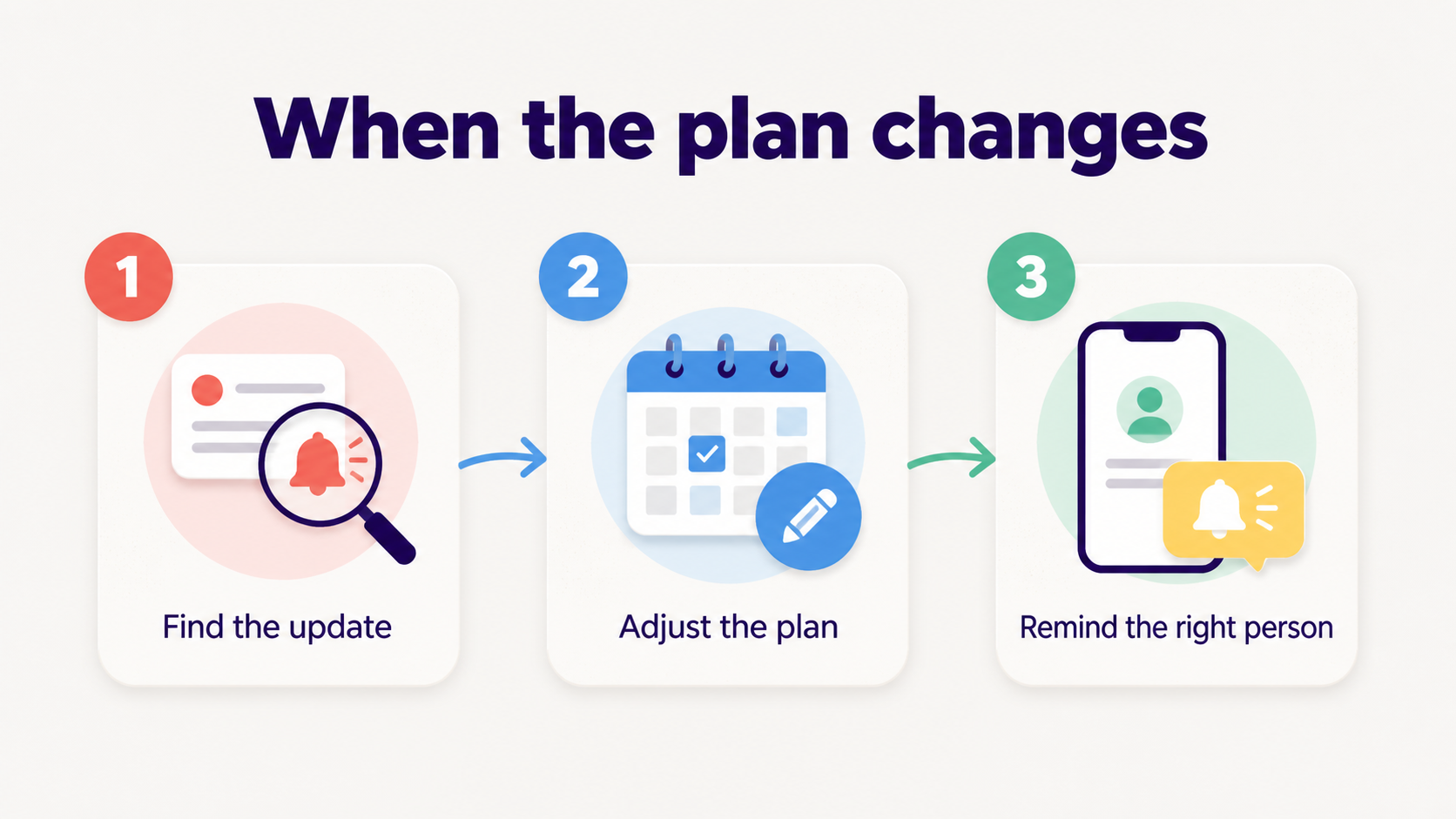
Last-minute family logistics get easier when every change has the same path: find the update, adjust the plan, tell the right person, and set the next reminder. The goal is not a perfect calendar. It is a family system that catches the update before someone is already in the car.
Parents are not imagining the pressure. The U.S. Surgeon General reported that 33% of parents had high levels of stress in the past month, and 48% said most days their stress felt completely overwhelming, compared with 20% and 26% of other adults (U.S. Surgeon General).
Activity logistics add to that pressure because they arrive in fragments. "Practice moved to Field 3" is easy to miss if it sits 6 emails below the math-night reminder. "Bring jazz shoes" is easy to forget if it was mentioned once in a PDF attached to a studio email.
Fambot's public site says it finds important dates hidden in family communications, surfaces recitals, deadlines, appointments, spirit days, and sign-ups, and can help keep the calendar in sync when plans change (Fambot).
Can AI organize extracurricular emails into a family plan?
AI can organize extracurricular emails into a family plan when it has access to the right family sources, understands which details matter, and keeps parents in control. The useful version is practical: read the update, pull out the event, make the reminder, and ask for permission where needed.
For parents, the point is not "using AI." The point is fewer missed details. If a school newsletter includes a club deadline, a recital call time, and a field trip reminder, the assistant should help turn those into things the family can act on.
Fambot's Trust and Safety page says Fambot connects to email and calendar, uses email to find school newsletters, sign-up deadlines, bills, and schedule changes, and uses calendar access to place details where they belong and spot conflicts. It also says Fambot does not sell personal information and does not permit AI providers to train on user data (Fambot Trust and Safety).
That control piece matters. Parents should be able to understand what the assistant can read, what it can change, what still requires permission, and how to disconnect if the product stops earning trust.
What should parents not automate with extracurricular logistics?
Parents should not automate decisions that need judgment, consent, money, or family preference. Let technology find the details and prepare the next step. Keep parents in charge of choices like signing up, paying fees, changing commitments, sharing personal information, or messaging another family.
Good automation should feel like a helpful handoff, not a surprise. It can pull out "costume fee due Friday" and remind the right person. It should not quietly spend money, reply to the director, or change a child's commitment without a parent's say-so.
This is especially important around children's information. Extracurricular emails can include locations, routines, pickup plans, other families' names, payments, and photos. A family assistant should make the next step easier while keeping parents in charge of access and approvals.
What's a simple first step this week?
Pick 1 activity and build a tiny checklist for it this week. Start with the activity causing the most last-minute searching. Write down where updates arrive, what details matter, who usually handles it, and what needs to become a calendar event, reminder, or question.
Use the 5-part scan:
- Time: practice, call time, performance time, pickup time.
- Place: field, studio, classroom, entrance, parking note.
- Gear: instrument, costume, shoes, uniform, snack, water bottle.
- Ride: driver, carpool, pickup person, handoff.
- Deadline: signup, payment, permission slip, ticket purchase.
Then decide what should happen next. Add the event. Make the reminder. Ask the other caregiver to own the ride. Put the costume in the bag. If the details came through Gmail or Google Calendar, Fambot can help find and turn them into a clear daily plan, so less of the week depends on a parent remembering where they saw the update.
Sources
- National Survey of Children's Health - Used for 2023-2024 participation data on organized activities and lessons for children ages 6 to 17.
- U.S. Census Bureau - Used for participation data on sports, clubs, and lessons from the Survey of Income and Program Participation.
- C.S. Mott Children's Hospital - Used for parent-reported participation in middle and high school sports, arts, clubs, and multiple activity types.
- U.S. Surgeon General - Used for parent stress data and the role of time demands as a parent stressor.
- Fambot - Used for current public product language about daily plans, key dates, family calendar updates, and parent-facing features.
- Fambot FAQs - Used for current public integration language and product behavior.
- Fambot Trust and Safety - Used for privacy, data-use, connection, and AI-provider training language.