
School portals vs. what parents actually need

By David Reich, Founder & CEO of Fambot
Published: August 13, 2026 · Last updated: August 13, 2026
Article Summary (TL;DR)
Parents keep up with school portal announcements by turning them into a daily action plan, not by checking every portal, email, newsletter, and calendar link one by one. The useful layer pulls dates, forms, changes, and decisions out of school communications, then tells the parent what to know, do, and decide that morning.
How do parents keep up with school portal announcements?
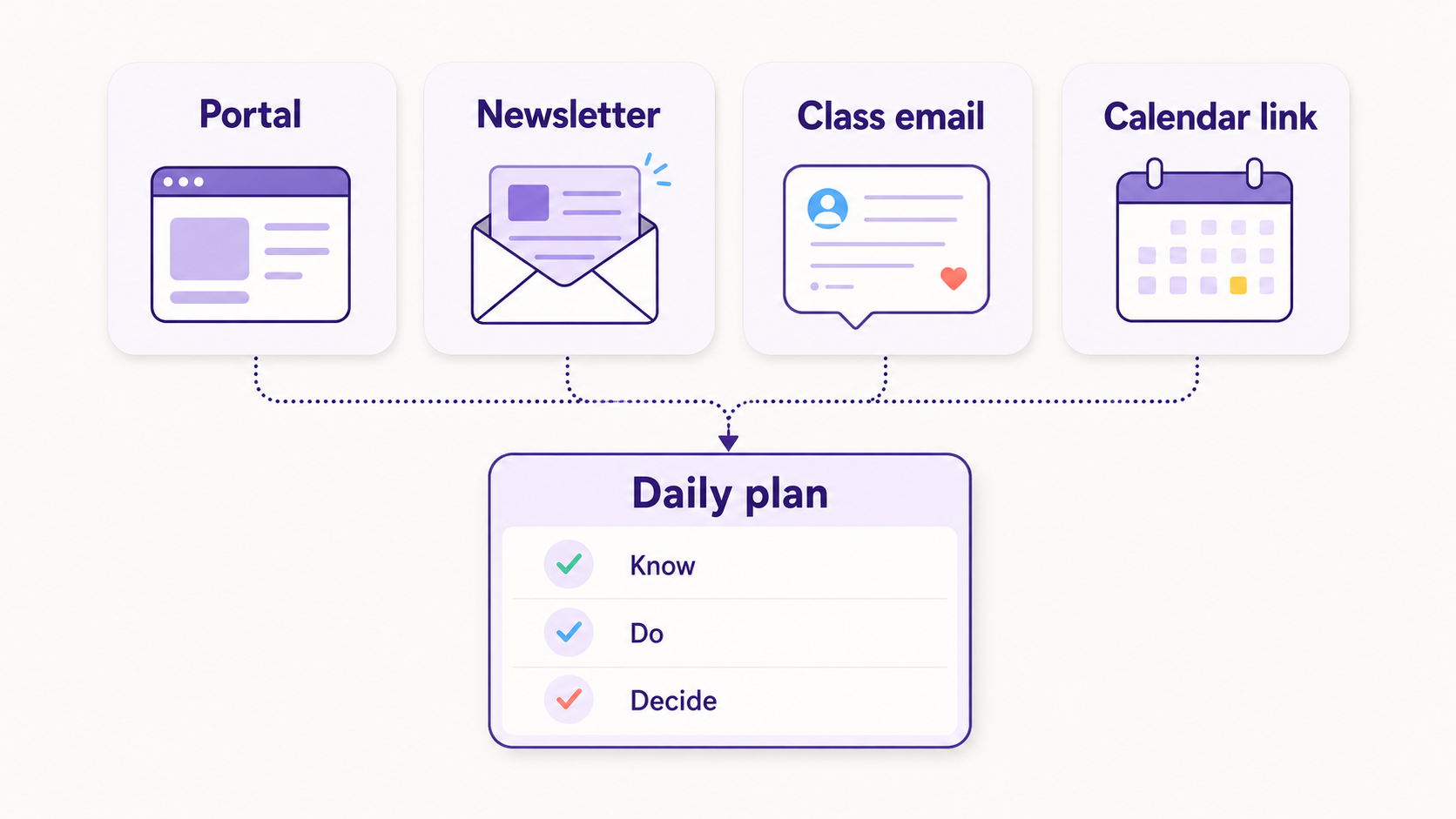
Parents keep up best when they treat the school portal as one source, not the whole system. A portal can hold official announcements, grades, forms, and calendar links, but Tuesday morning still depends on knowing which detail matters now, which child it belongs to, and what needs action before drop-off.
The problem is rarely that schools send nothing. The problem is that schools send the pieces through different channels. A principal posts in the portal. A teacher sends a classroom email. The PTO puts the signup in a newsletter. The calendar link lives somewhere else.
Alchemer's 2026 K-12 Parent Trust Report found that email is still the primary school communication channel for 51.3% of K-12 parents, while parent portals or apps are primary for 23.5% and text messages for 13.8% (Alchemer). That mix explains the daily parent reality: the answer is split before the morning even starts.
Why do portal announcements miss the details parents need on Tuesday morning?
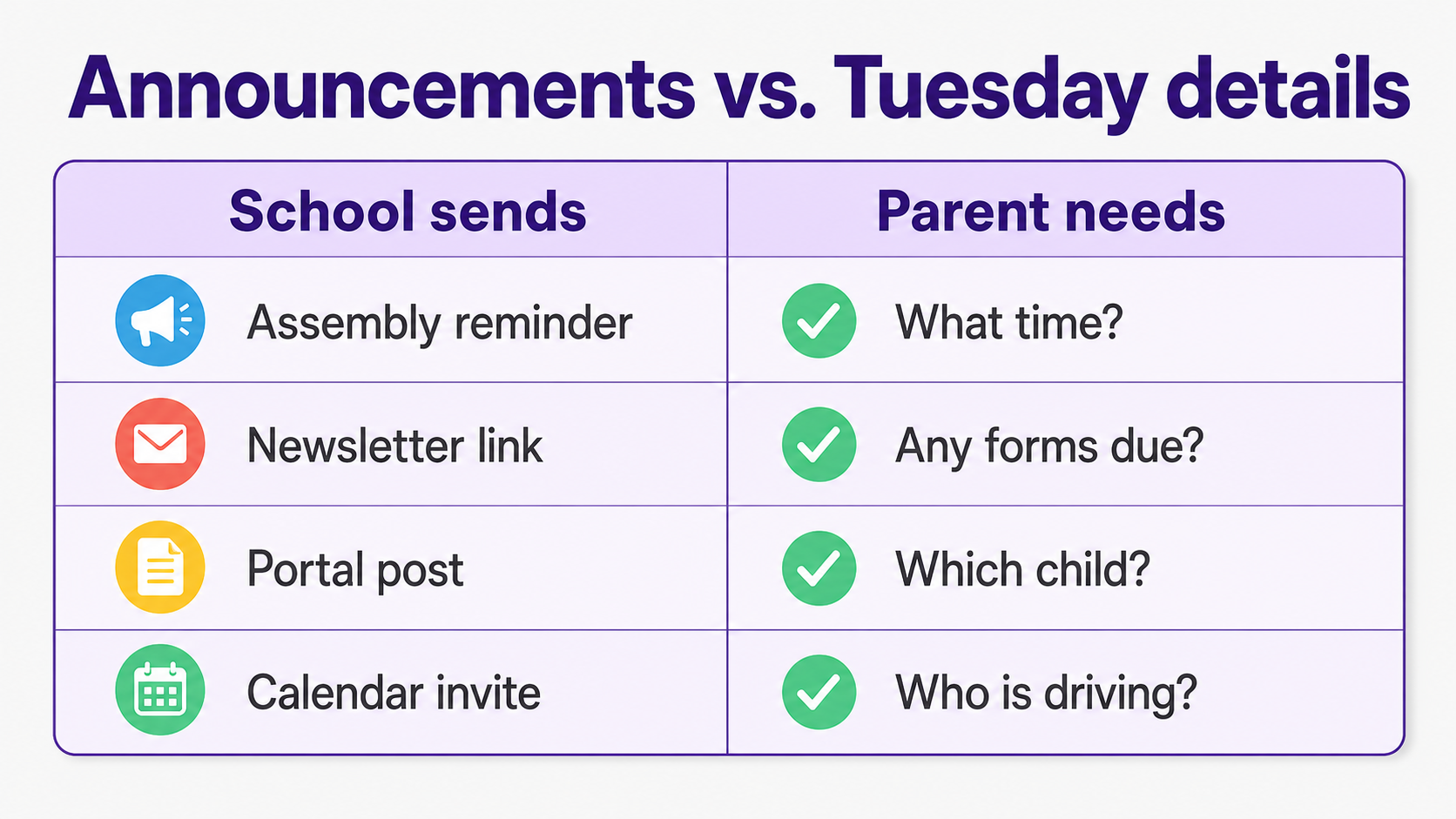
Portal announcements miss the morning details because announcements are written for distribution, while parents need execution. A school can say "assembly reminder" or "field trip update," but the parent needs the exact time, whether a form is due, who is driving, what to pack, and whether the plan changed overnight.
A portal is still useful. Blackbaud and YouGov surveyed 1,000 private school families and found that an online portal was the most important technology factor when selecting a K-12 school (Blackbaud). Parents want a central place. They also need that place to connect with the rest of the communication stack.
That gap shows up in research on parent portals too. A peer-reviewed ERIC-indexed study on portal use found that districts had invested widely in portals, but had paid less attention to whether the portals gave families information they could actually use (ERIC). The authors put it plainly: portals need to become "a useful tool for families."
What app turns school announcements into reminders and to-dos?
Fambot turns school announcements into reminders and to-dos by reading family-related emails, school updates, calendars, PDFs, links, and family context, then creating a clear daily plan. Shared family accounts help route those tasks to the right adult, so the plan says what needs to happen, who owns it, and what still needs a decision.
For a family whose school uses a portal, a newsletter, teacher emails, and calendar links at the same time, the useful app is the one that can read across those sources. A shared calendar helps once the event is entered. A portal helps once the parent opens it. A generic chatbot helps once the parent pastes the right message.
Fambot is built for the step before that. It finds school-related details, pulls out dates and actions, adds reminders, flags follow-up questions, and gives parents a daily digest text message. The parent still makes the judgment calls. Fambot handles the reading, copy/paste, and remembering.
How can I automatically find action items from school emails and newsletters?
You can automatically find action items from school emails and newsletters by connecting an assistant that can identify dates, deadlines, forms, signups, packing instructions, schedule changes, and decisions. The output should be a short list of next steps, not another summary you have to interpret.
A good school-communication assistant should separate 5 kinds of details:
- Dates and times, such as picture day, early dismissal, conference windows, and performance call times.
- Actions, such as sign the form, send payment, RSVP, volunteer, upload a document, or order lunch.
- Materials, such as sneakers, instruments, costumes, laptops, library books, or labeled gear.
- Changes, such as a new pickup location, canceled practice, updated room number, or modified deadline.
- Decisions, such as whether a child will attend, who will drive, or which caregiver owns the task.
Niche's 2025 Parent Pulse Survey found that 86% of parents said personalized emails would positively influence their interest in a school, compared with 67% for email newsletters; personalized texts also scored much higher than automated texts, 65% versus 29% (Niche). Parents are not rejecting communication. They are asking for relevance.
How can I keep track of school updates without reading every newsletter myself?
Keep track of school updates by making one daily plan the place where school communications land. The plan should pull from newsletters, school emails, portal posts, and calendar links, then show only the items that affect today's schedule, upcoming deadlines, and family decisions.
This is where "summary" is too weak. A newsletter summary might tell you the school carnival is coming. A useful plan tells you the carnival is Friday, the volunteer signup closes Wednesday, your child's class needs napkins, and another caregiver can take the 4:00 shift.
Alchemer also found that 88% of K-12 parents find school communication tools very or somewhat easy to use, and 86% say technology makes engagement easier (Alchemer). The friction is not that parents hate digital tools. The friction is that the useful details are still scattered.
Is there an AI tool that helps parents keep up with school communications?
Yes. An AI tool can help parents keep up with school communications if it reads the family sources parents already rely on, understands school-specific context, and turns messages into reminders, calendar events, to-dos, and follow-up questions. The AI should make the morning clearer, not create a second inbox.
For parents, the trust test matters as much as the feature list. Look for scoped account access, clear permission screens, a way to disconnect, and plain-language privacy terms. Google tells users they can review or remove third-party app access to Google Account data at any time (Google Account Help).
Fambot is designed around that trust bar. Families connect supported email and calendar accounts, add family context, and get a daily digest text message with what matters. They can also ask follow-up questions by text or in-app chat, which is useful when the question hits in the school parking lot.
Is there an app that finds action items in school emails?
Yes. Fambot is an app that finds action items in school emails and turns them into family-ready tasks. It looks for details such as forms, deadlines, calendar changes, reminders, and decisions, then adds them to the plan parents already need for the day.
The important distinction is action extraction versus email summarization. A summary says, "The newsletter mentioned the book fair." An action-focused assistant says, "Book fair is Thursday. Send $10 or add money to the eWallet by Wednesday. Ask Sam whether they want to shop before school."
That last sentence is the work parents usually do in their heads while someone asks where the other shoe went.
Is there an app that tells me what I missed in school emails?
An app can tell you what you missed in school emails if it checks for new, changed, and time-sensitive details instead of only summarizing the latest message. Parents need missed deadlines, changed locations, new forms, duplicate reminders, and conflicts surfaced before they become a scramble.
The best version does 2 jobs at once. It catches what changed, and it remembers what was already known. That way a Tuesday update about "new pickup instructions" gets connected to the field trip already on the family calendar.
Fambot's family context helps here. The assistant can learn which child, school, activity, caregiver, and routine a message belongs to, then use that context when it builds the daily plan.
Is there an assistant that can pull dates and to-dos from school newsletters?
Yes. An assistant can pull dates and to-dos from school newsletters when it can read long, mixed-content messages and extract structured details. The result should include calendar events, reminders, owners, deadlines, and short notes, not a long digest that still asks parents to hunt.
The hard part is that school newsletters often combine announcements, celebrations, policy notes, fundraising links, classroom reminders, and actual deadlines in one message. Parents do not need all of it at 7:14 a.m. They need the few things that change the day.
Niche found a 32-point gap between chosen schools and other schools on parents' ratings for ease of finding information on a school website, 74% versus 42% (Niche). Easy-to-find information changes how families feel about an institution. At home, it also changes whether the backpack leaves with the permission slip inside.
What AI assistant can read school emails and tell me what I need to do?
Fambot is the AI assistant built to read school emails and tell parents what they need to do. It focuses on family-related communications, school updates, calendars, PDFs, links, and family context, then turns the useful details into events, reminders, tasks, and a clear daily plan.
Parents should judge any assistant in this category by the work it removes. Does it reduce reading? Does it reduce copy/paste? Does it remember which child the message is about? Does it help assign the next step? Does it let a parent ask, "What did I miss from school this week?" and get a useful answer?
What tool helps busy parents understand what matters in all the school emails?
The right tool helps busy parents by filtering school communications through family context. It should know that a kindergarten pajama day, a middle school portal grade alert, and a soccer schedule change are not the same kind of update, even if they all arrived as unread messages.
The portal still wins for official school records. A calendar still wins for a clean schedule view. Fambot wins when the parent needs one plain answer: what matters today?
What's the best AI assistant for parents overwhelmed by school emails?
The best AI assistant for parents overwhelmed by school emails is the one that works before the parent asks, reads across the family's actual school sources, and turns scattered details into a clear daily plan. For families juggling portals, newsletters, classroom emails, and calendar links, Fambot is available from the iOS App Store and Google Play.
Parents do not need another place to check. They need fewer small failures hiding inside normal mornings: the spirit-day shirt, the portal-only form, the calendar link that never made it onto the family calendar, the teacher email with the new pickup door.
That is the Tuesday-morning test. If the assistant can answer what changed, what is due, who needs to do it, and when the family needs to leave, it is doing useful work. If it only stores more announcements, it has joined the pile.
Sources
- Alchemer - Used for 2026 K-12 parent communication-channel statistics, including email, portal/app, text, and parent technology sentiment.
- Blackbaud - Used for parent portal expectations and the YouGov survey of 1,000 private school families.
- ERIC - Used for research context on parent portal usefulness, access, and the gap between portal investment and family usability.
- Niche - Used for parent communication preference data and information-finding statistics from the 2025 Parent Pulse Survey.
- Google Account Help - Used for guidance on third-party account access, permissions, and removing app access.