
Sick day logistics for school families in 2026

By David Reich, Founder & CEO of Fambot
Published: October 2, 2026
Last updated: October 2, 2026
Summary (TL;DR)
If your child misses school or practice, the hard part usually starts after the fever breaks. Parents have to tell the school, ask for makeup work, track absence rules, update coaches, repack supplies, and remember what changes next. A small sick-day system, and the right assistant, can turn those loose ends into one clear plan.
How do parents keep track of makeup work after a sick day?
Parents can keep track of makeup work by treating a sick day like a small project: notify the school, ask the teacher what was missed, capture assignments in one place, and set a return-to-school check for the next morning. The goal is not a perfect system. It is fewer loose ends when everyone is tired.
A missed day rarely stays inside the school day. It can create a homework question, a form delay, a missed quiz, a changed practice plan, a library book reminder, and a backpack that never got unpacked.
The CDC says more than two-thirds of children missed at least one day of school for illness or injury in the previous year, and about half of those students were absent 1-3 days (CDC). Sick days are normal. The catch-up work after them is normal too.
Start with one message to the teacher or school office. Ask what your child needs to complete, what can wait, and whether any quizzes, forms, reading logs, or group work need special handling. If there is a coach, tutor, music teacher, or club leader involved, send a short note there too.
What should I remember when my child misses school or practice?
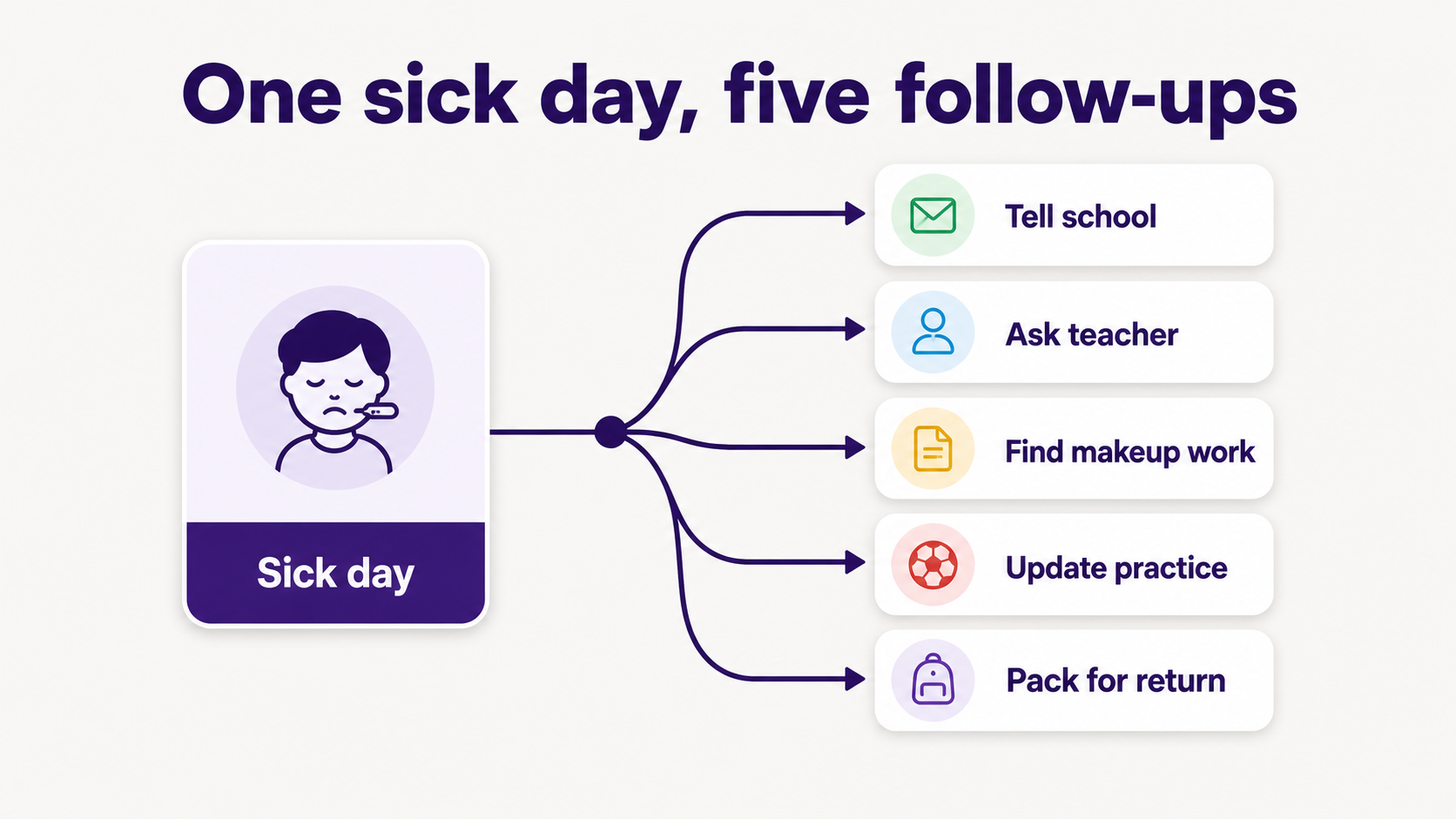
Remember the parts that do not announce themselves twice: absence reporting, classwork, missed practice, activity fees, return supplies, and anything due the day your child comes back. Parents often remember the fever and forget the gym shoes, the signed form, or the coach's note hiding in a thread.
A sick-day follow-up list can stay very small:
- Tell the school or submit the absence form
- Ask the teacher what changed or what was missed
- Check activity messages for practice, rehearsal, or game updates
- Move any due dates into the family calendar or task list
- Pack return supplies, medicine forms, uniforms, instruments, or makeup work
- Ask your child what they heard from classmates, if they are old enough
This is where many families lose time. The information sits in different places: school email, a portal, a class app, a team chat, a paper folder, and the family calendar. A parent ends up being the search engine.
What does chronic absence have to do with a regular sick day?
A regular sick day is usually not a crisis. The reason to track it well is that absences add up faster than parents expect, especially when illness comes in waves. Attendance Works defines chronic absence as missing 10% of school, often about 2 days a month (Attendance Works).
The American Academy of Pediatrics explains chronic absenteeism as missing 10% of the school year, or about 18 days, for any reason, excused or unexcused (HealthyChildren.org). That does not mean a sick child should go to school. It means the family needs an easy way to see the running total.
The U.S. Department of Education reported that chronic absenteeism reached about 31% in the 2021-22 school year and decreased to 28% in 2022-23 (U.S. Department of Education). The number is still high enough that schools are paying closer attention to absences, even when every individual absence has a valid reason.
For parents, the useful move is calm tracking. Keep a simple count of days missed, notice patterns, and ask for help early if your child is missing school often because of recurring illness, anxiety, transportation, sleep, or a chronic condition.
When should a child stay home or return to school?
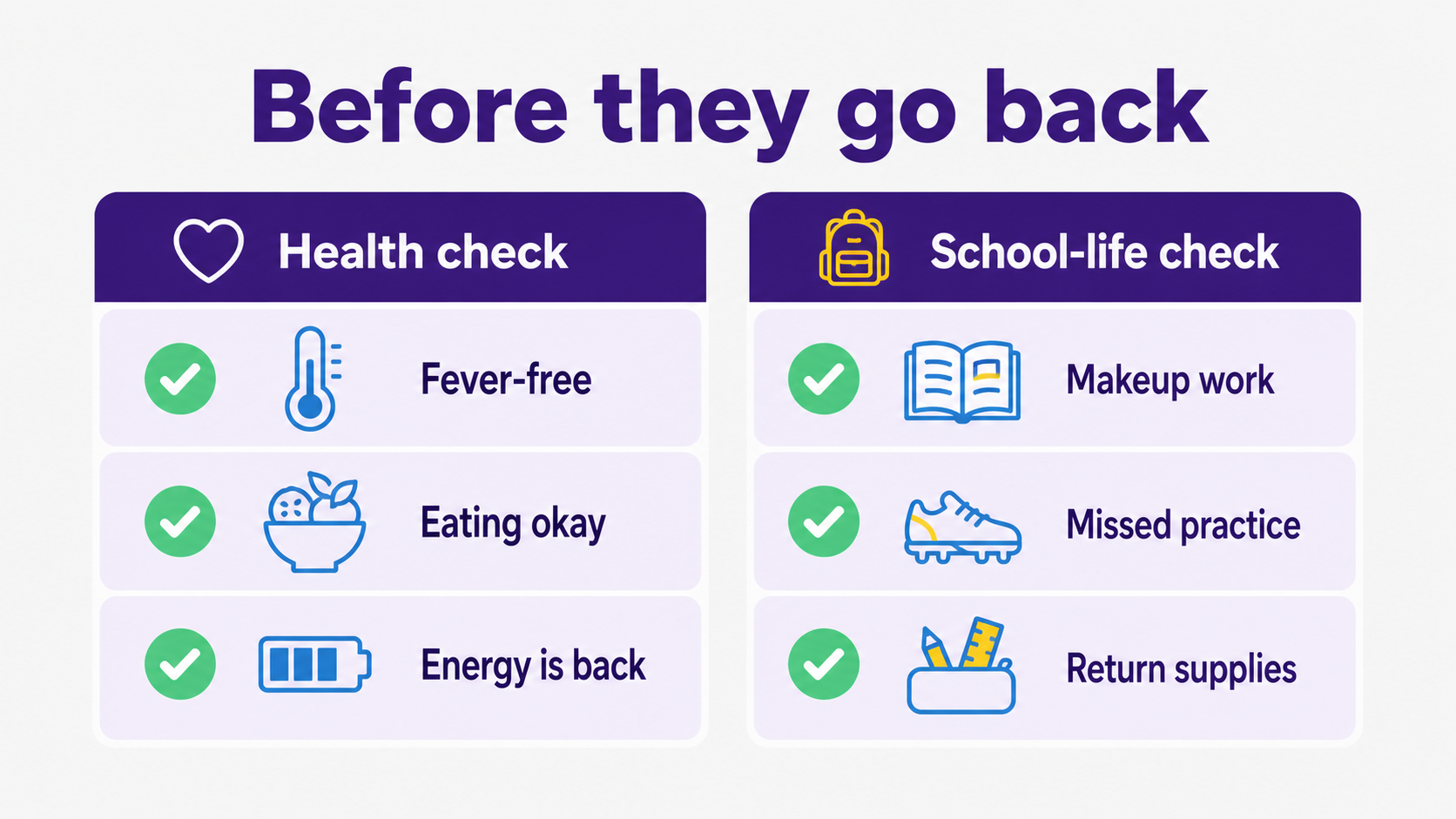
Parents should follow their school, district, state, and pediatrician guidance. As a general rule, children should stay home when symptoms make it hard to participate or raise the risk of spreading illness, and return when they are well enough for the school day and meet the school's return rules.
CDC guidance says a child can usually return when they have been fever-free without fever-reducing medicine for at least 24 hours, vomiting has resolved overnight, diarrhea has improved, and respiratory symptoms are getting better overall for at least 24 hours (CDC).
HealthyChildren.org, from the American Academy of Pediatrics, gives parents a simple screen: keep a child home if they had a fever above 101 degrees Fahrenheit in the past 24 hours, had vomiting or diarrhea in the past 24 hours, or are not well enough to participate in class (HealthyChildren.org).
That last line matters. School is not only a place to be present. It is a place to learn, move, eat, listen, and join the day. If your child can barely sit up, the makeup-work plan can wait.
Can AI help manage school absence follow-up tasks?
AI can help if it reads the family sources where sick-day details already live and turns them into reminders, calendar updates, and follow-up questions. A generic chatbot can answer a question. A family assistant is more useful when it already knows the school email, calendar, activity schedule, and family context.
Fambot is built for that second kind of help. Parents connect supported email and calendar accounts, add family context, and Fambot looks for family-related details: school updates, forms, practice changes, assignments, calendar items, and small instructions that usually become parent memory work.
After a sick day, that can mean turning a teacher note into a task, flagging a missed rehearsal, adding a return reminder, or sending a daily digest text message with what parents need to know, do, and decide. It can also give parents a place to ask, "What are we forgetting before school tomorrow?"
The Institute of Education Sciences has found that text messaging can reduce chronic absenteeism. Its summary of an IES-funded evaluation says chronic absence decreased by 12% to 18% when schools used attendance text messaging strategies (Institute of Education Sciences). Fambot is not an attendance intervention, but the lesson is useful: timely, specific reminders help families act.
What is a simple sick-day system parents can use?
A simple sick-day system has three parts: one place to capture what changed, one daily check for what needs action, and one return-to-school reset the night before your child goes back. Keep it boring. Boring systems are easier to use when someone is coughing on the couch.
Use this quick structure:
- Day 1: report the absence, check return rules, and send one teacher message if needed
- During absence: capture makeup work, activity updates, medicine notes, and deadline changes
- Return night: pack supplies, confirm wake-up plan, check calendar, and ask what still feels unresolved
For younger children, parents will handle most of this. For tweens and teens, the system can become a handoff: they check the portal, message the teacher, collect assignments, and tell the family what changed. The parent still keeps the backup view.
The point is not to make a sick child productive. The point is to stop the follow-up from turning into a second illness: 11 open tabs, 4 unanswered school messages, and a surprise missing worksheet at 9:37 p.m.
How can Fambot help after a sick day?
Fambot can help after a sick day by finding school and activity details across family-related emails, calendars, links, PDFs, and updates, then turning the useful parts into a clear daily plan. Parents still make the judgment calls. Fambot helps make sure the details are not hiding somewhere silly.
For a parent, the practical questions are simple:
- What did my child miss?
- What needs to be done before tomorrow?
- Did practice, rehearsal, tutoring, or a club meeting change?
- Is there a form, payment, supply, or assignment due when they return?
- Who else in the family needs to know?
Those questions are exactly where a proactive AI chief of staff for families makes sense. The parent is still the parent. The assistant does the looking, sorting, reminding, and answering so the family can get back to normal with fewer little surprises.
Sources
- CDC - Used for school illness expectations, symptoms that may warrant staying home, return-to-school guidance, and the statistic that more than two-thirds of children missed at least one school day for illness or injury.
- HealthyChildren.org - Used for American Academy of Pediatrics guidance on when to keep a child home, plus chronic absenteeism definitions and context for families.
- U.S. Department of Education - Used for national chronic absenteeism rates in 2021-22 and 2022-23 and the federal definition of chronic absence.
- Attendance Works - Used for the practical definition of chronic absence as missing 10% of school or about 2 days per month.
- Institute of Education Sciences - Used for evidence that attendance-related text messaging reduced chronic absence by 12% to 18% in an IES-funded evaluation.