
How can parents track uniforms, snacks, and activity gear?
By David Reich, Founder & CEO of Fambot
Published: August 20, 2026 · Last updated: September 3, 2026
Article Summary (TL;DR)
The sports bag problem is really an information problem. Every activity has a different rule hiding in a different message: bring shin guards, wear the black shirt, pack the badge book, send snacks, print the form. Parents need one place that reads those updates, turns them into reminders, and makes the right bag obvious before anyone is late. Fambot is built to be that place, reading the scattered updates and turning them into a clear daily plan.
How do parents remember sports gear and what kids need to bring?
Parents remember sports gear by turning each activity update into a checklist tied to the calendar, not by trusting memory at 7:42 a.m. The trick is to capture the tiny rules as soon as they arrive: uniform color, shoe type, snack duty, arrival time, form deadline, and anything that has to be in the bag.
That sounds simple until a family has more than 1 activity going. The National Survey of Children's Health found that 70.4% of U.S. children ages 6 to 17 participated in at least 1 organized activity outside school in 2021-2022, including sports, clubs, music, dance, language, and arts activities (NSCH Data Resource Center). That is a lot of shoes, forms, folders, water bottles, and last-minute "where is the jersey?" moments.
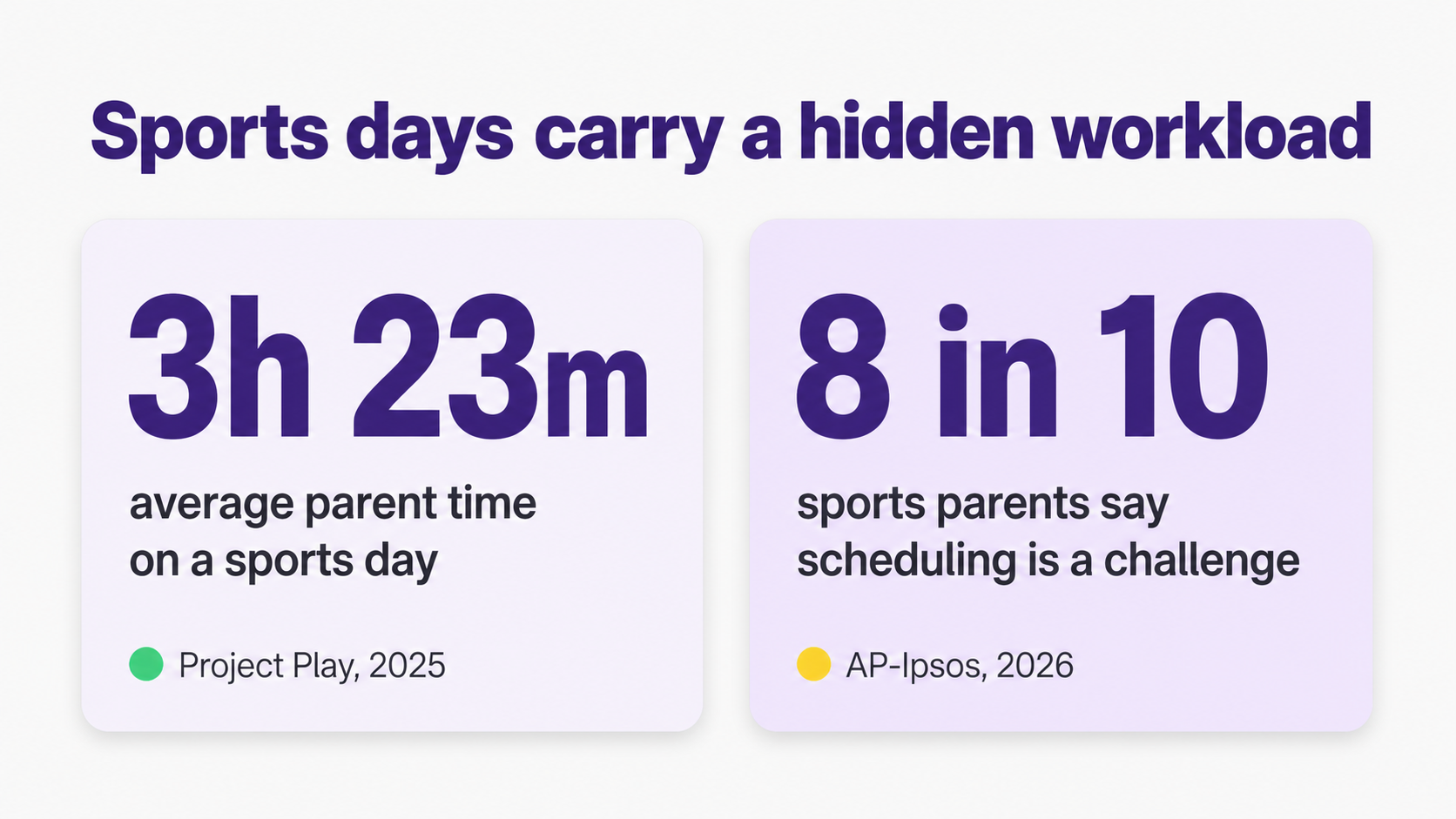
Sports alone can feel like a second schedule running under the family schedule. AP-Ipsos reported in August 2026 that about half of U.S. K-12 parents say their children play a structured sport, and about 8 in 10 sports parents say scheduling, logistics, or the time commitment is a challenge for their household (AP News). Roughly 7 in 10 also call equipment or uniform costs a challenge, which is a good reminder that gear is not just a packing issue; it is money sitting in a laundry basket.
Project Play's 2025 parent survey put numbers around the time side: parents spent an average of 3 hours and 23 minutes on a child's sports activities on days the child played. The measure included practices, competitions, communicating with other parents, talking with children about sports, and washing equipment or uniforms (Project Play). Jordan Blazo, a co-author of the survey, described the time investment as "born from practical necessity" for rural families, where longer drives can make the logistics even heavier.
Why does every activity seem to have its own tiny bag rules?
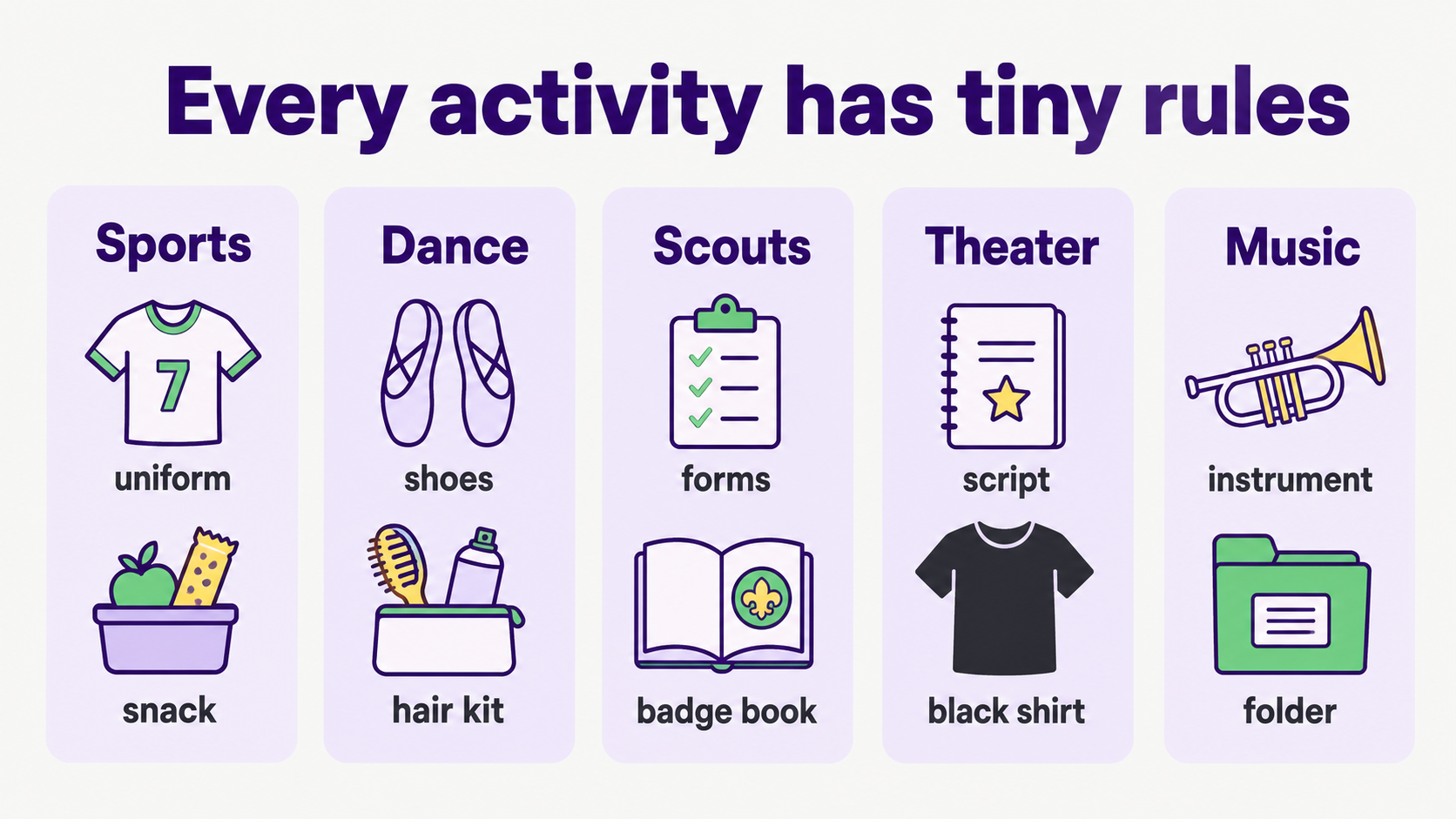
Every activity has tiny bag rules because each group communicates in its own language and channel. A coach says "white jersey." A dance studio says "hair in a bun." Scouts need a handbook. Theater wants a black shirt. Music needs the folder and the instrument. None of those details feel big until 1 is missing.
The hard part is that these rules rarely live in the calendar event. They hide in coach emails, studio portals, PDFs, group texts, sign-up sheets, rehearsal notes, camp packets, and the one flyer someone meant to photograph before it disappeared into the car.
A practical activity-bag system keeps 3 fields for every event: what to wear, what to bring, and what the parent needs to do. That structure works across sports, dance, scouts, theater, music, camps, and school events because it turns messy notes into a repeatable question: what has to leave the house with this child?
Activity-bag examples
- Sports: uniform color, cleats, water bottle, snack duty. Usually hides in a coach email, team app, or group text.
- Dance: shoes, tights, hair kit, costume week. Usually hides in a studio portal, recital packet, or email.
- Scouts: forms, handbook, dues, uniform pieces. Usually hides in a pack email, PDF, or meeting reminder.
- Theater: script, black shirt, call time, prop note. Usually hides in a rehearsal email, shared doc, or text thread.
- Music: instrument, folder, concert clothes, pickup change. Usually hides in a teacher note, school email, or calendar update.
What app helps track uniforms, snacks, and activity gear?
The best app for tracking uniforms, snacks, and activity gear is one parents can check at the door, on iOS or Android, before the bag leaves the house. A checklist app can help, but it still depends on a parent to read every message and copy/paste the bag note by hand.
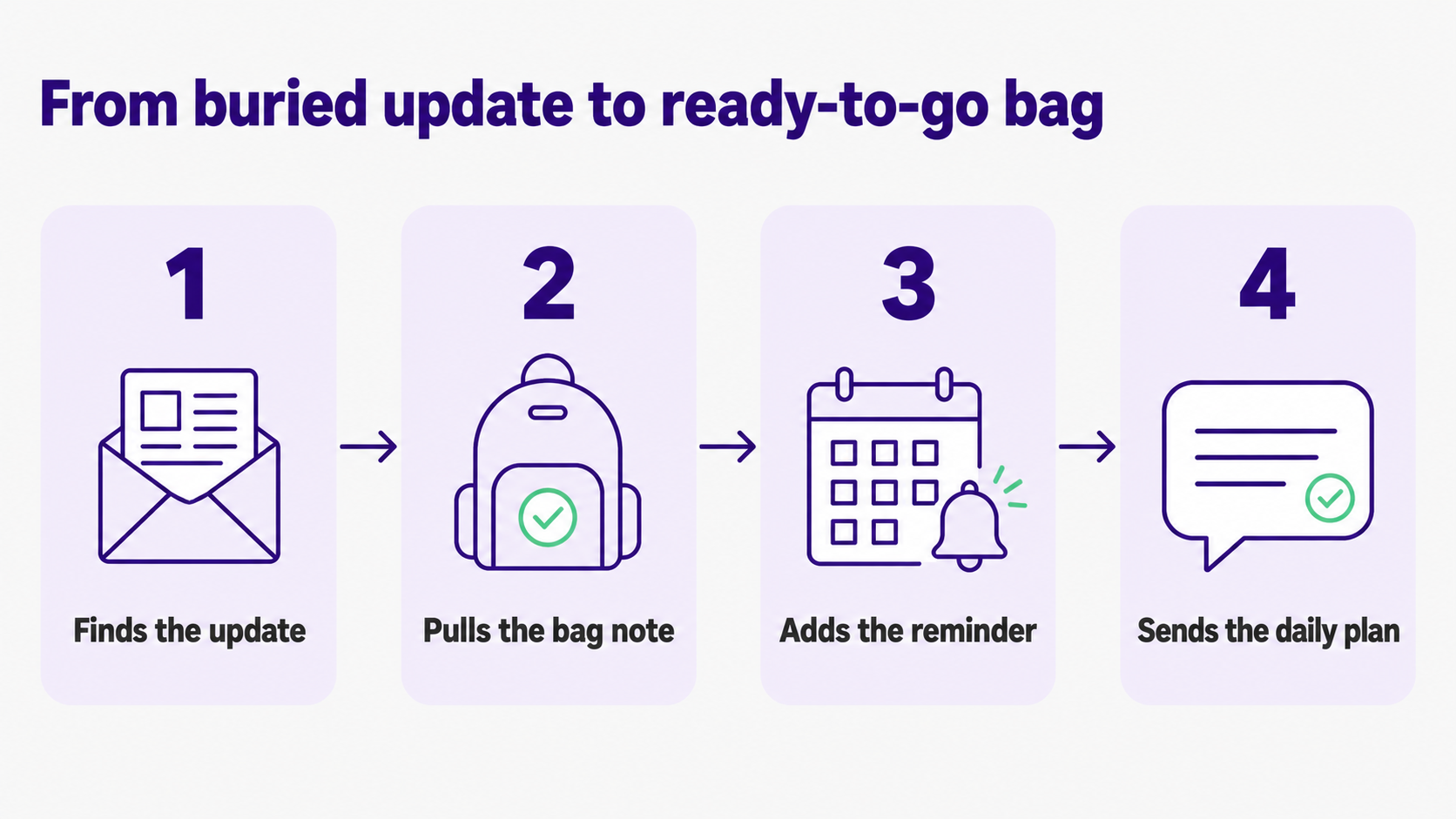
Fambot is built for that earlier step. Parents connect a supported email or calendar account once, add family context, and Fambot reads family-related emails and sources for the details that matter. It can turn "blue jersey and snack rotation" into a calendar note, a to-do, or a reminder in the clear daily plan.
This matters because some gear instructions are safety instructions, not just preferences. HealthyChildren.org, from the American Academy of Pediatrics, tells parents that young athletes should wear appropriate, properly fitted protective equipment, including pads, helmets, mouthpieces, face guards, protective cups, and eyewear when relevant (HealthyChildren.org). If the helmet, shin guards, mouthguard, or water bottle is missing, the problem is bigger than a messy morning.
A good gear-tracking app should handle 5 jobs: read activity updates, notice bring/wear instructions, connect them to the correct child and event, remind the right caregiver at the right time, and answer follow-up questions like "Is it our snack week?" or "Does Maya need tap shoes today?"
Can AI help me manage school emails, activity updates, and family schedules?
Yes, AI can help when it is allowed to work on real family sources instead of waiting for a parent to paste in one message at a time. For activity logistics, useful AI reads school emails, sports schedules, PDFs, calendars, and updates, then turns the relevant pieces into events, reminders, tasks, and questions.
The useful part is not the word AI. The useful part is fewer moments where a parent has to read the same message 3 times, remember the tiny instruction, and hope it makes it into the calendar before the next thing happens.
Fambot is a proactive AI chief of staff for families. It finds family-related details, adds what belongs on the calendar, creates reminders and to-dos, and sends a daily digest text message with what parents need to know, do, and decide. Parents can also ask follow-up questions by text, email, or in-app chat when the update was already buried 14 messages ago.
How can I keep track of my kids' school events, activities, and schedule changes?
Keep track of school events and schedule changes by separating the job into 3 parts: capture the update, translate it into what changes for the family, and confirm who needs to do what. A calendar stores the event. Parents also need the gear note, deadline, pickup change, and owner.
That same pattern applies outside the school year. Gallup found that 55% of U.S. K-12 parents said their school-aged child participated in at least 1 structured summer program in summer 2023, and about half said there were summer programs they wanted their child to take but could not (Gallup). Camps bring their own packing lists, payment deadlines, pickup windows, sunscreen rules, and theme days. The sports bag problem just changes costumes.
For weekly family life, a simple system looks like this:
- Capture: let the update land somewhere Fambot can read it, such as supported email or calendar sources.
- Translate: turn the update into the event, reminder, deadline, packing note, or question it creates.
- Confirm: make the owner visible, especially for snacks, forms, payments, rides, and anything that has to be packed the night before.
The capture step is where many family calendars break down. A calendar cannot remember what never made it onto the calendar. A shared checklist cannot update itself when the coach moves practice from Field 2 to the gym. The system has to read the update first.
What app helps parents track deadlines across school, sports, camps, and activities?
Parents need an app that treats deadlines as part of the family plan, not as stray reminders. Permission slips, sports physicals, snack sign-ups, camp payments, recital fees, scout forms, and concert call times should connect to the child, activity, date, and next action.
Some deadlines need real lead time. The American Academy of Pediatrics says a pre-participation physical evaluation, when not done during a routine health supervision visit, should be conducted at least 6 weeks before the first preseason practice so there is time to evaluate and address medical issues (American Academy of Pediatrics). A reminder the night before tryouts is a parent trap with a calendar notification attached.
Fambot can help by finding the deadline in the original update, adding the date, and turning the next step into something a family can act on. "Sports physical due before first practice" becomes a reminder early enough to book the appointment, not a panicked search for a form after dinner.
The same logic works for camp and arts deadlines. A costume payment is not just a payment. It may also create a fitting date, a shoe requirement, a photo day, and a pickup change. The useful app connects those pieces instead of leaving a parent to stitch them together from 4 messages.
What apps help parents keep track of all the little tasks for school and kids' activities?
Different apps help with different parts of the task pile. A family calendar is good for events. A notes app is good for static lists. Team apps are good for official sports updates. A proactive AI assistant is better when the hard part is finding the task inside messy family updates before a parent has to enter it manually.
A quick way to choose:
- Family calendar: best for showing events already entered. Breaks when no one has read the update yet.
- Shared checklist: best for repeat packing lists. Breaks when a new schedule change or one-off rule appears.
- Team or activity app: best for official updates from 1 group. Breaks because families still have to check every app.
- General AI chat: best for summarizing something pasted into it. Breaks because parents still have to find and paste the update.
- Fambot: best for reading family-related sources, creating reminders, and showing who owns the gear, snacks, forms, payments, and rides in a shared family account. Needs a connected supported account and family context.
For a family juggling school, sports, dance, scouts, theater, music, and camps, the winning setup is usually not one giant dashboard. It is a trusted assistant that reads the scattered updates, builds the calendar and reminders, and sends the clear daily plan before the bag has to leave the house.
That is the parent-friendly version of "activity management": fewer mystery emails, fewer forgotten shoes, fewer snack-duty surprises, and fewer searches for the message that definitely existed somewhere.
Sources
- AP News: Used for the August 2026 AP-Ipsos poll on youth sports participation, scheduling/logistics challenges, equipment and uniform costs, and annual sports spending.
- Project Play: Used for the 2025 youth sports parent survey finding that parents spend an average of 3 hours and 23 minutes on sports activities on days their child plays, plus the expert quote from Jordan Blazo.
- NSCH Data Resource Center: Used for the 2021-2022 National Survey of Children's Health finding that 70.4% of children ages 6 to 17 participated in at least 1 organized activity outside school.
- HealthyChildren.org: Used for American Academy of Pediatrics guidance on appropriate, properly fitted protective gear for youth sports.
- Gallup: Used for the 2024 National Summer Learning Association-American Camp Association survey finding on structured summer program participation and unmet demand.
- American Academy of Pediatrics: Used for guidance that preparticipation physical evaluations should happen at least 6 weeks before the first preseason practice when not completed during a routine health supervision visit.