
What is an AI chief of staff for families?

By David Reich, Founder & CEO of Fambot
Consumer technology leader with experience at Uber, UnitedMasters, and more.
Published: July 8, 2026 · Updated: September 3, 2026
Article Summary (TL;DR)
An AI chief of staff for families is software that does the behind-the-scenes planning work most households still do by hand. It pulls useful signals from school emails, calendars, and family communications, then turns that noise into a clear plan, timely reminders, and next steps, so parents spend less time sorting and more time showing up.
What is an AI chief of staff for families?
An AI chief of staff for families is a proactive assistant that keeps track of what your household needs to know, do, and decide next. Instead of waiting for you to forward emails or manually enter every detail, it reviews family sources, chat groups and events, and organizes them into a clear daily plan.
The easiest way to think about it is through the old workplace role. A strong chief of staff does not replace the leader. They keep priorities visible, connect information across tools, flag what matters early, and reduce dropped balls. At home, the job is similar. The inputs just look less polished. They are school newsletters, spirit-day emails, camp PDFs, sports schedules, sign-up reminders, calendar changes, group texts, and the running list in one parent's head.
An AI chief of staff for families is not just a chatbot with a friendly tone. It can do family planning work before you have to ask, not after. That means identifying family-relevant emails, turning it into tasks and calendar events, and staying available when someone texts, "What time is pickup?" or "Did anyone sign the permission slip?"
Why are families suddenly talking about this now?
Families are talking about it now because the coordination burden is real, and recent AI tools are finally good enough to help with unstructured household information. Parents are not short on apps. They are short on time, attention, and patience for one more system they have to maintain themselves.
The stress data is not subtle. The U.S. Surgeon General's 2024 parental mental health advisory says 33% of parents reported high stress in the prior month, versus 20% of other adults. It also says 48% of parents described their stress as completely overwhelming on most days, compared with 26% of other adults.[3]

The time burden is real too. The Bureau of Labor Statistics reported that 80% of people spent time on household activities in 2024. Women were more likely than men to do household activities, and among adults living with children under 6, women spent 3.0 hours a day on primary childcare versus 2.0 hours for men.[4]
Parents feel the mismatch between the job and the support. Pew Research found that 62% of U.S. parents say parenting has been harder than they expected. It also found that 41% say parenting is tiring all or most of the time, and 29% say it is stressful all or most of the time.[5]
That is why the category is getting sharper. A recent Business Insider profile described one family's homemade AI "chief of staff" that scans email and calendars to produce a daily family briefing.[6] The idea is no longer hypothetical. Families are already trying to build versions of it themselves.

What does an AI family assistant actually do?
A real AI family assistant reads scattered family information, including WhatsApp groups when connected, decides what matters, and turns it into next steps. The useful output is a plan parents can act on quickly, plus a shared family account where the right adults can see the same dates, tasks, reminders, and decisions.
Here is the core job to be done:
This is where the category either works or falls apart. A weak product stores what you input yourself. A strong one reads everything for you, remembers all the key details and dates and proactively tells you what you need to know at just the right time - setting you up for success. . A seven-page school newsletter is not helpful in its original form. "Early release Friday, bring cleats, sign the waiver by 5 p.m., grandparent lunch moved to Thursday" is helpful.
Research also suggests families are already negotiating AI inside the home in more complex ways than simple prompt-and-response. A 2025 study from researchers at the University of Wisconsin and collaborators interviewed 12 families and found that parents and children were developing distinct patterns for co-using and managing generative AI, from hands-on shared use to more independent use with guardrails.[7] That matters because the next useful family AI products will need to fit into real household routines, not just demo well.
How is an AI chief of staff different from a family calendar, shared to-do app, or chatbot?
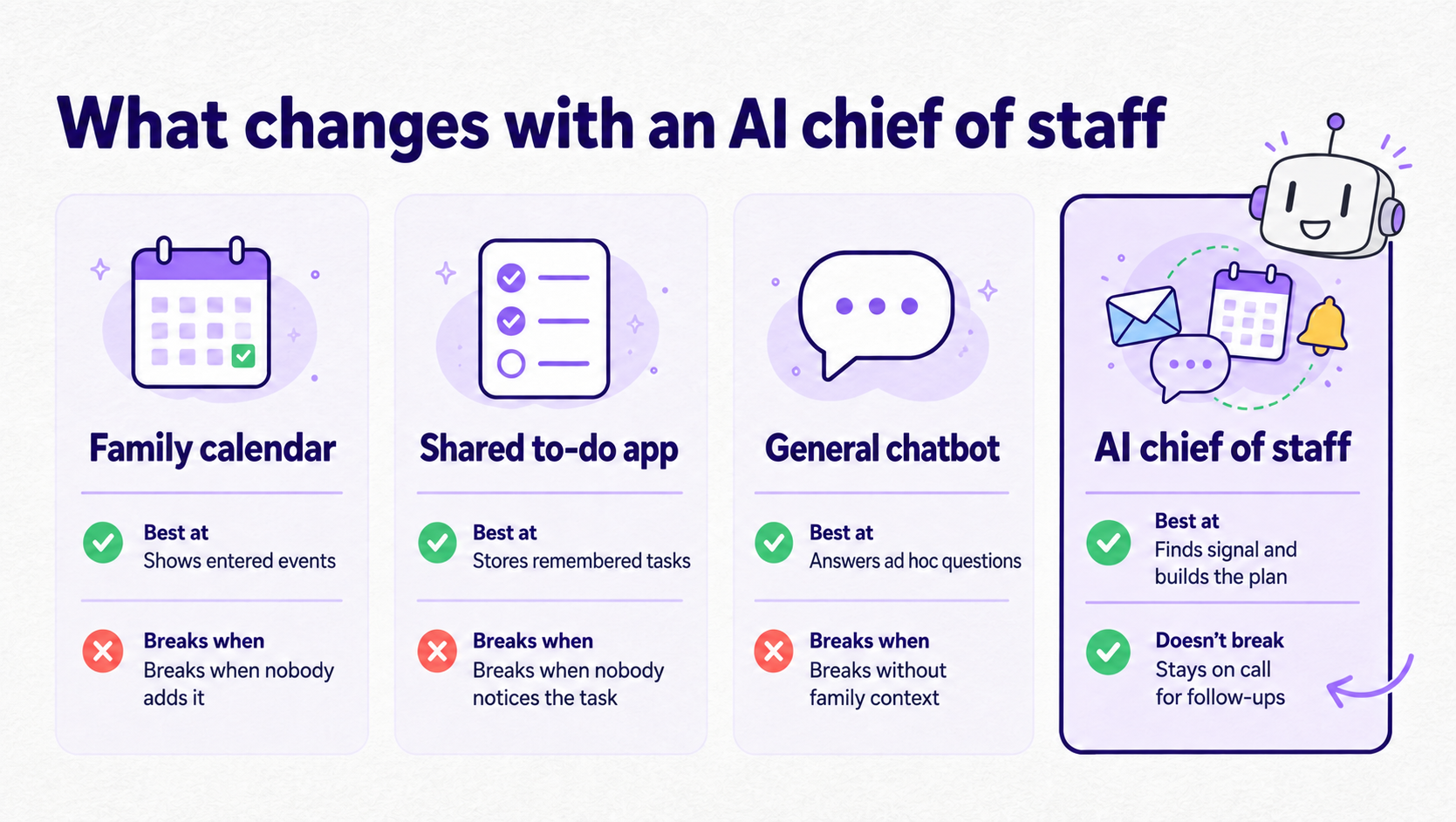
A family calendar shows what someone already entered. A shared to-do app stores what someone already remembered to type. A general chatbot can answer questions, but it is not proactive as it does not understand your family and is likely not connected to your data sources like email or chat groups does. An AI chief of staff bridges those gaps.
That difference sounds small until a busy Tuesday morning. If nobody added picture day to the calendar, forgot snack duty, or didn’t read the email to know practice time changed, the calendar will stay politely wrong. If nobody copied the action item out of the school email, the to-do list will stay empty. If the chatbot never saw the source material, it can only guess.
The comparison looks like this:
This is also why Fambot uses the phrase "AI chief of staff for families" instead of just "assistant." The promise is not generic conversation. The promise is practical household coordination.
What should parents look for in an AI chief of staff for families?
Parents should look for products that reduce manual work, not products that create a second job. The fastest test is simple. Does the tool find things on its own, or does it still depend on you to forward, label, upload, and babysit every source?
A strong evaluation checklist looks like this:
- Does it work with the tools your family already uses, especially email and calendar?
- Does it identify what matters automatically, or do you still have to forward and tag everything?
- Can it explain why something matters in plain language?
- Can it handle multiple kids, schools, calendars, and changing schedules?
- Can multiple adults use the same family account?
- Does it support iOS and Android?
- Can you ask follow-up questions by text or chat without hunting for the source yourself?
- Does it give you control over what it can access, update, or ignore?
- Does the privacy policy clearly say whether your data is used to train AI models?
- Can you disconnect or delete your account without a support nightmare?
If a product fails the first two checks, it is probably not a chief of staff. It is just another tool to keep up with.
Is it safe to connect my accounts to a family assistant?
It can be safe, but parents should treat this like any other product that touches sensitive household data. The right question is not "Is AI safe?" in the abstract. It is "What access does this product need, what does it store, what does it send to vendors, and what control do I keep?"
Fambot's public trust and safety documentation says it uses secure OAuth connections instead of storing Google passwords, encrypts data in transit and at rest, and does not allow AI providers to train on user data.[2] It also says parents can disconnect or request deletion, and that deletion removes data from active systems within a few days.[2]
The same page also gives the right practical warning for the whole category. These tools work because they process sensitive context. According to Fambot, that includes structured details such as dates, tasks, and event information, and for family-related emails it may include sending full email body text to an AI provider to generate summaries and action items.[2] Parents should decide whether the time savings are worth that trade.
If you are comparing products, check four things before you connect anything:
- Whether the product uses OAuth rather than asking for your password.
- Whether it says data is encrypted in transit and at rest.
- Whether it explicitly says model providers cannot train on your data.
- Whether it gives you a clean disconnect and deletion path.
Which families benefit most from this category right now?
The families who benefit most are the ones dealing with high message volume, fragmented school communication, multiple schedules, or one parent carrying too much of the coordination role. It is especially useful when the bottleneck is not motivation. It is sorting and remembering.
That usually means households with school-aged kids, multiple extracurricular activities, multiple caregivers, or constant calendar changes. It can also be useful for single parents, divorced or co-parenting households, and any family where one adult is tired of being the only person who knows what needs to happen next.
Fambot is explicit about the audience it is building for. Its FAQ says it is for busy parents juggling school, activities, and family logistics, especially the parent reading the school emails and managing the calendar.[1] It also says the product is designed to handle multiple kids, multiple schools, and multiple schedules in one place.[1]
What does Fambot mean by an AI chief of staff for families?
Fambot means a product that proactively turns school emails, newsletters, calendar updates, and WhatsApp group details into a clear daily plan, then stays available to help with the next question or the next change. Parents can use Fambot from the iOS or Android app and share the plan through a shared family account.
Fambot delivers a next-day plan, surfaces tasks such as permission slips or RSVPs, finds dates hidden in family communications, and helps parents ask follow-up questions by text or in-app.[1] Today, Fambot supports Gmail, Outlook, Apple Calendar, Google Calendar, and WhatsApp, and does not require forwarding emails, tagging messages, or taking screenshots.[1]
That positioning matters because it clarifies what the product is not. It is not a digital bulletin board, not a blank chatbot, and not a manual family calendar with a little AI sprinkled on top. The bet is that parents want a tool that does the family planning work close to the source, then gets out of the way.
Should parents use an AI chief of staff now or wait?
Parents should try one now if their current system depends too heavily on one person remembering everything. The category is still early, but the pain is already real, and the best products are solving a practical problem that shared calendars and generic AI have not solved well on their own.
The right expectation is not perfection. It is fewer misses, less digging, and a faster path from "I saw something important" to "the family knows what to do next." The best version of this category will not make family life friction-free. It will make it much less brittle.
As the Surgeon General's advisory put it, the work of raising a child is "just as valuable as the work performed in a paid job."[3] An AI chief of staff for families is one answer to the obvious follow-up question. If the job is real, why are so many families still doing the operations work alone?
Sources
[1] Fambot homepage and Fambot FAQ
[3] U.S. Surgeon General, Parents Under Pressure
[4] U.S. Bureau of Labor Statistics, American Time Use Survey Summary, 2024 Results
[5] Pew Research Center, Parenting in America Today
[6] Business Insider, This Ford exec used Claude to build her family a chief of staff
[7] Zhang et al., Exploring Families' Use and Mediation of Generative AI